

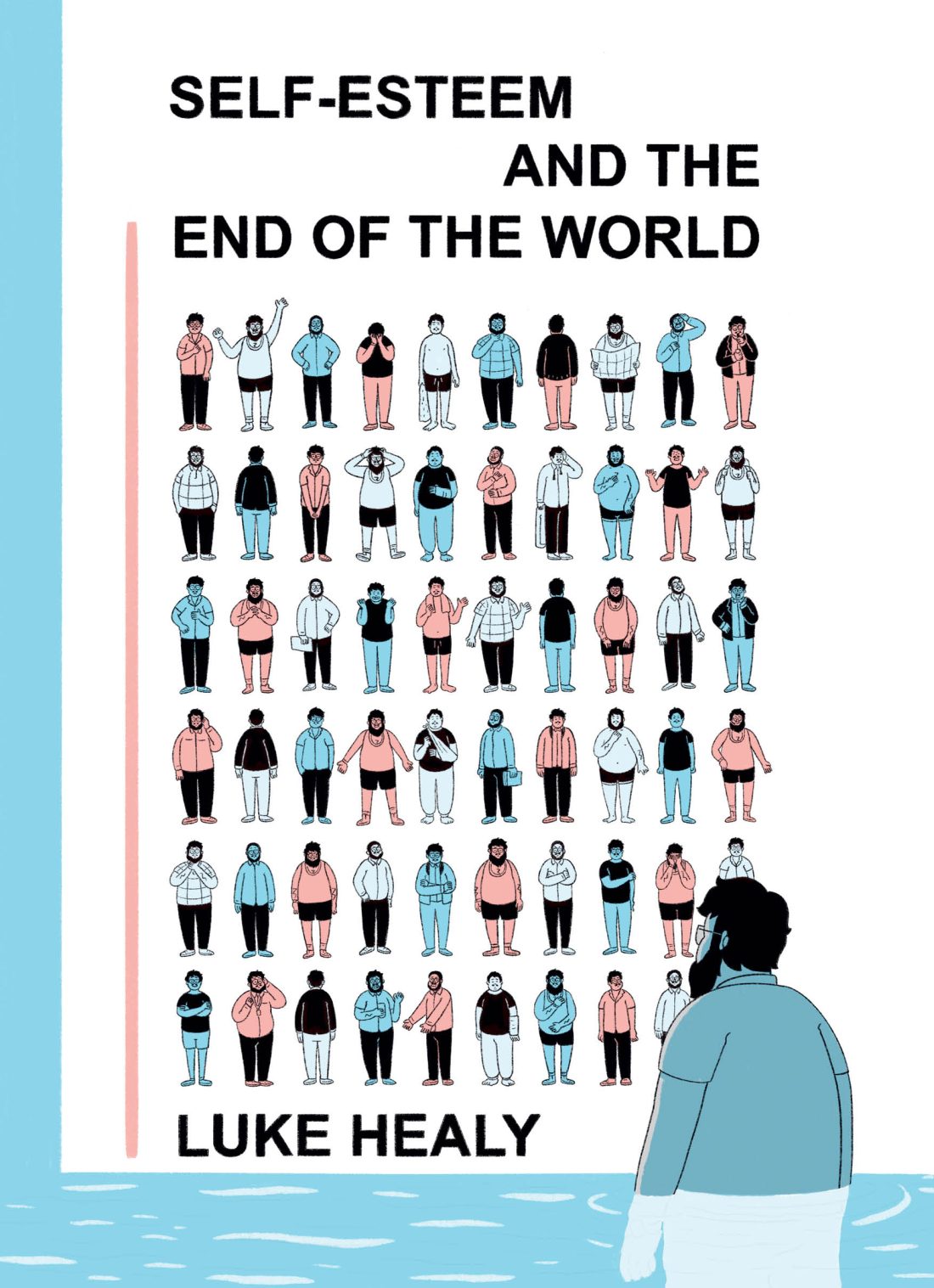
In a world on the verge of ecological collapse, Luke Healy’s latest graphic novel, “Self-Esteem and the End of the World,” offers a poignant and introspective look at the intertwining of personal crisis and global catastrophe. With his characteristic blend of humor and heartache, Healy crafts a narrative that is both deeply personal and universally relevant. It slices through the facade of everyday life to expose the raw nerves of our existence. Luke Healy’s work is a masterclass in the art of autofiction, blending internal struggles with the larger, looming external disasters of our time.

The protagonist, a thinly veiled version of Healy himself, is a beleaguered cartoonist who has tethered his sense of self to the whims of a fickle audience and the capricious nature of the publishing world. He slowly becomes adrift in a sea of self-doubt after his twin brother delivers a critique not just of his latest work, but of his very essence. As the world faces its literal rising tide, Luke’s personal flood comes in the form of existential questions: What is an artist without acclaim? What is a man without a reflection?

As his career crumbles amidst a pandemic, paper shortages, and the ensuing chaos of supply chain disruptions, he finds his life in disarray. Relegated to the monotony of call center labor, he embodies the struggle of the modern artist: the search for meaning in a world that seems to be careening towards its own end. The art is a quiet triumph, with Healy’s clean lines and muted colors capturing the stillness of a world on the brink. Each panel is a meditation, a moment of stillness in the rush toward oblivion. Yet within this quietude, there is movement—a subtle yet profound shift as the protagonist redefines himself amidst the crumbling world he knows.
His ability to convey complex feelings through seemingly simple lines is a testament to his skill as a visual storyteller. The book’s 324 pages are a testament to Healy’s commitment to exploring the themes of identity, self-worth, and resilience in the face of adversity.
Fans of Healy’s previous works, such as “Americana (And the Act of Getting Over It)” and “How to Survive in the North,” will find familiar themes of exploration and introspection. However, “Self-Esteem and the End of the World” stands out for its raw honesty and vulnerability. Healy’s narrative here is a tightrope walk between the absurdity of self-obsession and the undeniable gravity of global crises. His line work mirrors his wit, capturing the essence of a generation caught between the desire for personal significance and the overwhelming forces of nature.
This is not a story that coddles its readers with false hope or neat conclusions. Instead, it offers a piercing look at the human condition, a reflection on what it means to be alive in an era where the personal and the planetary are inextricably linked. It’s a story told with a smirk, a shrug, and a profound sense of irony.

“Self-Esteem and the End of the World” is a graphic novel for those who have ever felt overshadowed by their own life, for anyone who has questioned their worth as the ground gives way beneath them. We are all Luke, staring down the apocalypse with a quip on our lips and a tremble in our hearts. Healy’s genius lies in his ability to make us laugh at the very things that scare us the most. It is a story for the end of days, yes, but more importantly, it is a story for the beginning of understanding.