

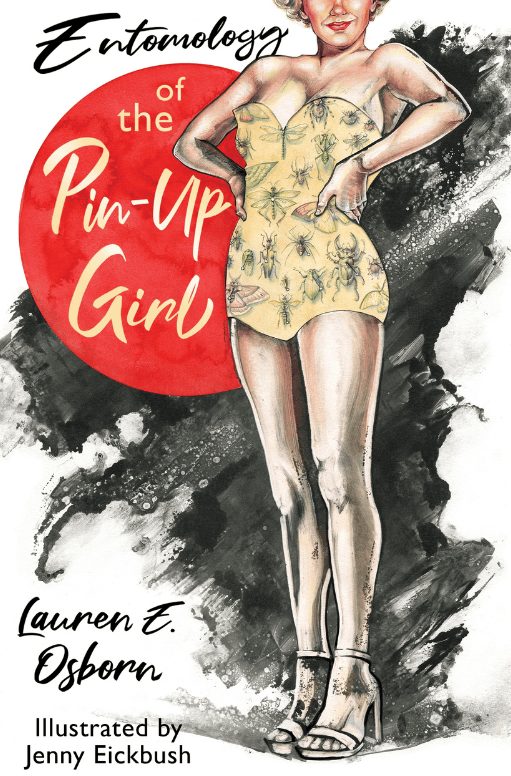
There’s something deeply seductive yet disconcerting about preserving dead things that still appear alive. Most of us learned that young. We think about the bugs that we legitimately had to collect and pin up in our high school bio classes. Our minds drift toward the Playboy we see taped to our friend’s lockers. The contrast between the two is startling but tantalizing all in the same breath. The fact that a title alone could evoke so many concepts and thoughts at once is what makes this collection stand apart from most.
It’s filled with women becoming insects and wives cocooning themselves away from their husbands. There are teenage girls who embrace decay which isn’t too far off from how they already are and bodies mutating beneath society’s pressure of appetite and observation. What Lauren E. Osborn intimately demonstrates beyond all that is that the real horror of the book isn’t metamorphosis. It’s preservation. Suspended autonomy for all to observe. It’s here where illustrations by Jenny Eickbush excel. She toys with visions of glamorous decay while Lauren presents us with the idea of the “monstrous feminine.” A concept that sounds like something that could easily collapse into aesthetic TikTok weirdness or overly pretentious body horror. But, Osborn resists pandering to an easy audience and fully commits to the grotesque. The stories that fill this collection are visceral. Sticky. It’s full of exoskeletons, silk, decay, and hunger. It’s devoted to women who no longer fit cleanly into the categories and roles that the world assigned them.
The whole project comes back to the title. Osborn has discussed in the past that she made a connection between pinned insects and pin-up girls after first encountering the French film critic, André Bazin’s, essay with the same name. That understanding actually mirrors the collection perfectly. These stories are obsessed with women being observed, categorized, displayed, preserved, consumed. The horror comes from the fact that the specimens are still moving.
One of the smartest things the collection does is refuse to turn transformation into a clean metaphor. When Grete Samsa wakes up as a monstrous camel spider instead of Gregor becoming a cockroach, the story doesn’t wait for the reader to catch up and interpret it for them. It dives in. The women in these stories do not transcend their bodies. They molt deeper into them.
A lot of contemporary literary horror wants to be called “unsettling” while still remaining tasteful. Entomology of the Pin-Up Girl is willing to actually be disgusting. Teenage girls embrace decay as fashion. Housewives cocoon themselves like moths away from their husbands. Hunger perpetuates a cycle of mutation into intimacy and intimacy that keeps mutating into predation. The collection was originally titled Eaters of Men, which makes perfect sense once you’re inside these stories. Nearly every piece circles appetite in some form. Emotional appetite. Sexual appetite. Biological appetite. The terror of wanting too much and being punished for it.
The comparisons to Kafka, Karen Russell, Aimee Bender, and K-Ming Chang are accurate, but what separates Osborn from a lot of the current wave of “feminine grotesque” fiction is the collection’s sense of conceptual unity. The entomology framework gives the book an actual skeleton. Every story feels pinned into the same shadowbox.
The prose itself is lush without collapsing under its own weight. Osborn understands restraint. She knows when to let an image sit there and rot. There’s confidence in the writing that a lot of debut collections lack. The stories don’t beg to be understood. They simply continue unfolding like something biological under glass.
What stayed with me most after finishing the collection wasn’t necessarily the horror imagery. Though there’s plenty of that and then some. It was the weight of the sadness underneath everything. The feeling that these women are mutating because the world has already rendered them into specimens long before the transformations begin.
Entomology of the Pin-Up Girl is a collection about becoming monstrous after realizing you were already being pinned in place.
You can grab a copy now from Dzanc Books.