

…a lot of people get scared when they hear they’re walking over dead people. Although we are all, more or less always walking over a greater or lesser number of dead. There are many more dead people than living; it’s a simple truth: we all end up turned to earth.
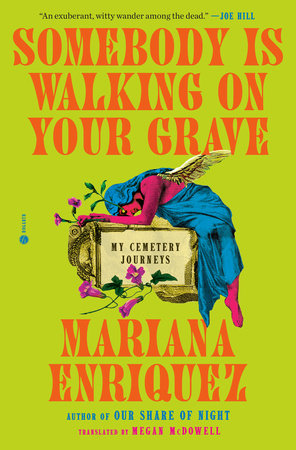
I’ve been involved with more than one woman who was fond of visiting cemeteries they had no personal stake in. Call it morbid curiosity, fidelity to an aesthetic, or fascination with a certain kind of historical documentation, someone who devotes vacations or other free time to boneyards is not the average citizen. I’ve always just tagged along so I can’t pinpoint the appeal but to those who have the bug, the pull graveside seems irresistible. Mariana Enriquez makes a case for necro-tourism so convincingly in this delightful memoir/pocket primer that I wouldn’t be surprised many readers might book their passage to the nearest resting place immediately after putting it down.
Enriquez starts off with a bang. She makes a date with a handsome busker in Genoa and, inspired no doubt by the sexy statuary, has her way with him amongst the dearly departed. This is the earliest episode in the book, occurring in 1997, when the author is in her twenties, and she restrains herself for the most part the rest of the way. At least as far as what she chooses to share in these pages. But the impulse to engage in other physical and emotional ways with these sometimes sacred spaces never leaves her.
Covering three continents and twenty-plus years, Enriquez’s travelog is equally generous with historical and personal detail. A celebrated writer, often invited to literary events the world over, she takes any available downtime to wander an Australian necropolis or a Chilean ossuary, dragging along boyfriends, husbands, or oft-reticent friends and colleagues. None match her wonder and glee wandering among markers to people none of them met or had any obvious connection to. Her loved ones don’t begrudge her fascination even if they’re often baffled by it.
When Enriquez returns from the Paris Catacombs with a pilfered bone, her host doesn’t allow her to keep the relic inside the apartment. It must be hidden behind a hallway plant. Later, when Enriquez asks her mother, a doctor, to determine what part of the anatomy the bone fragment came from, her mother refuses full-stop, wondering aloud about her daughter’s sanity. And yet Enriquez is utterly sane. She’s simply a person with a particular preoccupation.
She ends her tour in her native Argentina just ahead of COVID lockdown, relating to enthralled out-of-town friends the truly fantastical epic journey of Eva Peron’s corpse, which was buried and exhumed multiple times, held as a political bargaining chip, and even molested by necrophiliac military men before coming to final rest below eight feet of poured concrete in Buenos Aires’ Recoleta Cemetery. It’s a tale worthy of the horror fictions Enriquez is best known for but doesn’t require any flights of fancy.
But it’s the quieter moments in the book that stay with me most. That’s when Enriquez gets to the heart of her lifelong pull graveside. After following her through these pages, many of us wouldn’t fight the urge to come along with her.
How beautiful cemeteries are, I think as I look out the window at the gray sky. […] Where the name and the date remain, a voice that says: I was here, now I’m gone. Maybe no one knows my name anymore, but someday someone will remember me.