

This morning’s run to the ATM was harrowing. I dipped into savings! Seventh time this month. I tell Alicia all this in the middle of my second mojito.
“Look, until the card declines it’s no one’s business,” she says, pulling her sunglasses down over her eyes. We both turn toward the street where a long-haired dachshund is taking a wet shit over a subway grate.
“I don’t mean to suggest I’m not having a great time here,” I say, dragging my fork through a swirl of beans and egg yolk that has crusted over around the edges, “but it’s exhausting, right? Being almost always just a little broke?”
“Bullshit,” she says. “You’re too damn cautious all the time. The absolute paradigm of personal responsibility. Someone should slap your mug on a subway ad. One of the queer lines, like the Q or M.”
“Not the G?”
“God, no,” she says, and waves me off.
The waitress arrives to clear our plates and we order another round of drinks. The drinks are why Alicia prefers to come here for brunch. I like it because they offer a “passport” breakfast special: Costa Rican on Mondays, Colombian on Tuesdays, then Venezuelan, Ecuadorian, and finally Mexican. Inside the menu each dish is rendered as an emoji and splashed across its respective country on a map of Latin America. I look over the options and fantasize about showing the actual passport collecting dust on my nightstand a little razzle dazzle, too.
I pull out my wallet and count my bills. Alicia does the same, scrunching her lips to the side. She separates two twenties from the rest of the stack. “This should be enough for groceries,” she says, placing the two bills beneath her bra strap, then mentions her job is hosting a mandatory return-to-office potluck. She’s not one to lose, wants to hit them with something good. A Melissa Clark recipe but done up her way. “I want those crotchety office ladies on their hands and knees begging for my pie recipe,” she says.
This all sounds insane. I have worked from home since long before the pandemic, doing payroll for startups that outsource their HR departments because, though they’re obligated to have one, in practice they seldom adhere to any guidelines, legal or ethical. They’re built on vibes, luring in young talent with sexy benefits they’re reprimanded for using. I pick up my coffee and ask instead where Alicia will do her grocery shopping.
She closes her eyes to concentrate, solving for X. She might stop at the Whole Foods several blocks north of us for sugar and flour, then the nearby Trader Joe’s for nuts, ending at the grocery store closest to her apartment for butter and eggs. She doesn’t want to walk more than four blocks with anything from the dairy section rattling around in her threadbare tote bag. She cracks her knuckles and finishes her third mojito in one gulp; the damp mint leaves spring out from between her teeth. Through the green she says, “These bitches won’t know what hit them.”
I met Alicia when I moved into the Bushwick apartment she shared with four other queers. At the time, I believed my reasons for moving to Bushwick absolved me of any perceived contributions to gentrification because my mother had grown up in an apartment on the corner of Knickerbocker and Harman, which I considered my ancestral homeland. On the phone, after I described to her my current living situation, my commute, my rent, and how my new best friend Alicia worked at a cheese shop Brooklyn Magazine described as “chic, yet unfussy” near Maria Hernandez Park, my mother sat silent for a good thirty seconds. Then, softly, as if to herself, she said, “Isn’t that where your tío Tony got jumped for selling cheap pot? They’re charging you how much to live there?”
We cohabitated with a revolving door of roommates whose trust-funds and oppositional astrology signs were a toxic cocktail. Roommates who claimed to have taxing jobs that stripped them of the ability to wash their dishes or take out the trash or clean after their unhousebroken dogs who puked or pissed on every stitch of fabric we owned. One day, our many problems were solved by a new one: a rent hike so steep Alicia and I were sent packing, forced to scatter across the boroughs—one of us up to Inwood, even—until we reunited two years ago as neighbors again in our equally brittle Flatbush apartments.
I no longer try to justify why I’ve moved where, but I am conscientious of where my money goes. At least that I can control.
I wait in line with Alicia to ask the fishmonger for a branzino with incredibly silvery skin. Branzino, a fish she has never eaten—she doesn’t even like fish—all because her favorite culinary influencer on Tiktok posted a recipe that she watched in the restaurant bathroom. I ask her about the flour and sugar, and she tells me I shouldn’t keep tabs on people like this. Once armed with her catch of the day we search the wide aisles for polenta, the starchy base to the influencer’s recipe. Neither of us keep it in our pantries and have only experienced it at trendy little Brooklyn restaurants the size of airplane bathrooms, where it is served in the form of crumbly, oil-sodden “fries.”
The air conditioning in Whole Foods is crisp and powerful. The less time we spend at home cranking our window units in the thick of summer, the less beating our wallets take. This is my best cost-saving tip.
Another tip: I no longer order delivery, at least not intentionally. I may call in an order for pick-up, limiting myself to restaurants within walking distance, around half a mile or so. Close enough to keep the food warmer than lukewarm. A full mile would require me to reheat everything. Hot food that has cooled and congealed becomes leftovers—if I arrive home with leftovers, I shove those containers into my fridge and break my own rule by ordering delivery to eat instead. I do this twice a week. And when a delivery guy seems hot from his photos on the app, I keep my shirt off while answering the door, offering some leg and a peek of my boldly-patterned underwear, until I can determine if he is actually hot. If he is, I linger in the doorway long after he hands me the food and walks back down to the lobby. I’m not after sex. A look, a friendly gesture, maybe. Someone who will slow it all down. I’ve been doing this for over six years and no one has ever taken the bait. This outcome always leaves me so low I no longer feel hungry. And isn’t that the greatest savings tip of all?
At Trader Joe’s, the fluorescent lights spark a transformation inside us. We are werewolves meeting the moonlight. We break off into parallel tornados in pursuit of snacks and frozen dumplings and packs of browning Brussels sprouts and green beans limpening into mush and rose facial mist that I don’t need but suddenly feel incomplete without. I load a loaf of cheesy-jalapeño bread on the brink of molding into my basket. These groceries are irresponsible. I can’t consume everything in time. As an adult, keeping a stocked fridge soothes financial anxieties held over from a childhood spent living paycheck-to-paycheck. My mother once made three trips to Walmart in two hours. The first time, she forgot the key ingredient for Bananas Foster, the dessert she wanted to make for the man who would eventually become my stepfather. On the second trip, she paid for the bananas but left the bag behind in her urgency to return home. Back to the store she went, in tears, frustrated over the gas she was wasting and money spent on fruit we wouldn’t eat. When she finally did remember the bananas, I didn’t have the heart to tell her they were far too green. We cooked the unripened fruit in brown sugar; I dusted them in Splenda. So unpalatable, the end result. An experience akin to chewing clay rolled in burnt-sugar. But we chewed and swallowed. We did not reveal our total disappointment. We did not create waste.
Back in our neighborhood, weighed down with reusable bags the cashiers guilted us into buying, we enter another grocery store. I scan the fresh produce, all of it marred with thorny price tags. Among the meats, I eye a T-bone: $23. Gray around the fat cap. A pack of chicken breasts costs nearly $12 for less than two pounds. Three uncomfortably thin pork chops seem reasonable at $2.54, so I grab the package and palm it like a serving tray while walking in a daze around the freezer, dairy fridge, and snack aisle. Pink liquid leaks through the plastic wrapping, dribbling down my forearm and onto my shirt. I had four alcoholic beverages at brunch. I am laced with rum and mint. I am drunk. The stocked shelves around me are a wired cage.
“Sir, sir,” a teenager is saying. I am present again, now in the check-out line, sticky with pork juice. “Are you okay?” He appears shaken, extending his open hands toward me but careful not to make contact.
“It’s the heat,” I say.
He nods. I’m not sure where Alicia is, whether she’s still shopping or has already paid. A thimble of a man lines up behind me. In his cart, there is a pack of plain bagels, silken tofu, three shallots, four red onions, one green onion, and the smallest vial of soy sauce.
“What are you making with all those alliums?” I ask him, and he jumps a little. He is white, thin, and boyish—these details convey to me that he doesn’t quite know what he’s doing.
“Oh,” he says, scratching the back of his neck. “Different recipes.”
“Alison Roman?” Though it could be a number of any trendy internet chefs. The ones who dictate our weekly shopping lists, who boast their stuffed fridges and complete pantries, who cook in front of cameras, inside new, polished homes, trying to convince us that a cooked meat atop a bed of greens, swimming in something lemony or vinegary, could reasonably feed two people. He grips the handle of his cart more tightly and forces a chuckle. We are all so connected.
The cashier taps me on the shoulder. “Excuse me, sir, are you paying for that? We need to move the line along.”
Alicia appears through a window near the exit. She’s dropped a few of her bags and is bent forward, trying to pick up the stray groceries. She’s straining to take hold of everything, grabbing nothing, and the few items she manages to scoop up and place back in a bag, hit the pavement again when the bag breaks. Items splat or shatter or become dented against the sidewalk, rolling out into the street. Her sunglasses are gone.
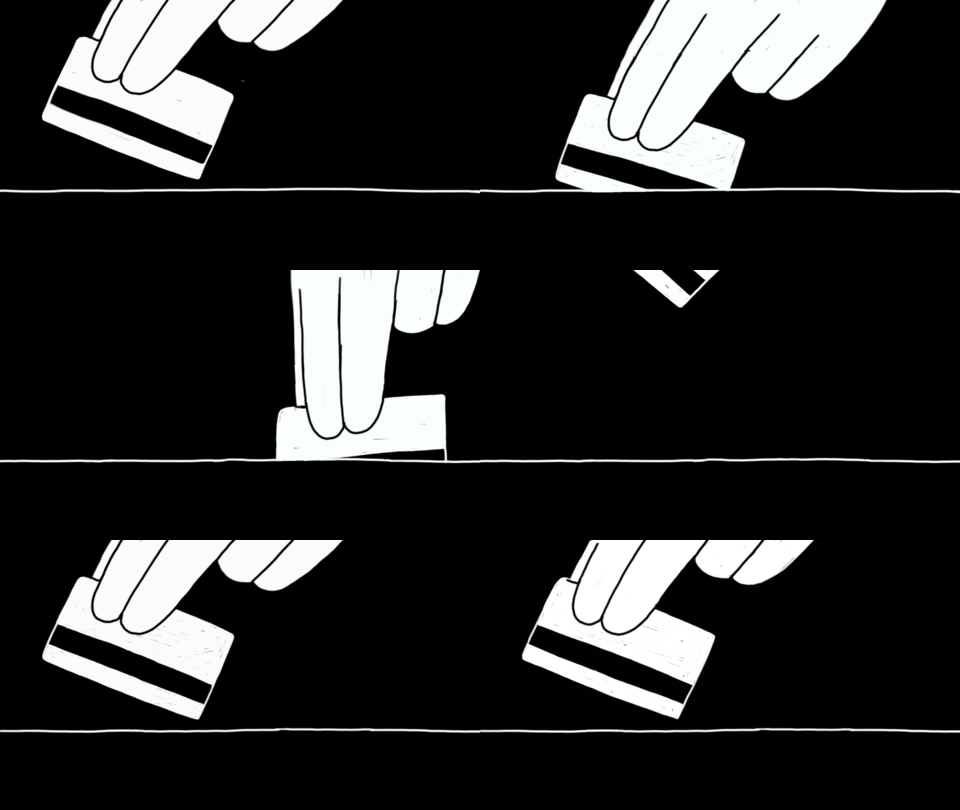
“Sorry,” I say, sensing the cashier’s increasing impatience. He’s standing with his arms folded, no longer making eye contact. I retrieve my card from my back pocket. I place it against the reader, but there is no beep or change on the screen.
“Oh,” he says, then taps his finger on a wrinkled Post-it note taped to the little shelf by the card reader. “It’s down at the moment.”
I am stunned, concerned. My shoulders ache from the tote bags. In my hands, the meat has become warm. No longer safe to cook. I don’t want this.
“We’re only taking cash,” he says.
Before the Bushwick apartment, I spent two weeks subletting in a South Brooklyn neighborhood with a 24-hour Key Foods the length of a block. Wandering back home from the F train, I would dip in and pick up an icy Russian beer and cold, pre-made chicken tenders, which I’d pay for in cash and eat ravenously on the rest of my walk home, tossing the glass and plastic into the nearest trash bin. (I did not recycle, then.) It was so comforting, the existence of this store. Its large, bright sign called to me through the darkness like a lighthouse across the sea. And even at 3AM, the store was abuzz with workers organizing the produce out front, shelving cereals and bags of potato chips, drumming their painted manicures along the cash register. I had no friends of my own. No home base. The Key Foods was a soft place to land after hours of dancing with sweaty, limber men and making out with them, sometimes doing more together, in dark rooms, for free drinks. Mostly vodka sodas I slurped down quickly to keep myself lubricated. Fluid. In total control as that world spun around and around. I’d stumble into my apartment with breaded chicken skin between my teeth, the beer-induced acid reflux crawling up my esophagus, and feel absolute glee over my final act of the night—spending my own money on myself.
Alicia and I finally arrive at the street corner between our apartments. We’re sweaty, beaten down by the sun, our shoulders and necks visibly pained. Her tote bags have torn; she’s missing whole items. The branzino with silvery skin slipped right beneath the tire of northbound B43. I’m missing everything. At the ATM in the front of the store, I over drafted. I abandoned the pork and my own tote bags by the register staffed with that teen boy who called out to me, waving his arms in the air, as I left the store and reentered the world.
“Starting over is not cost effective,” I say, and Alicia leans up, kisses me on the cheek. Her breath is slightly sour, vegetal, comforting.
“What happened today cannot happen again,” she says. She rubs her left eye, pats her round cheek. “We need to get ourselves together.”
But I know in my heart it will and in all the ways we won’t. Her thirtieth birthday trip, a week-long bender in Dublin; to avoid seasonal flooding, a sultry weekend in Madrid where the nights really start moments before the sun peeks through the sky, our bellies becoming equated with tortilla and jamón after hours of dancing and walking cobbled streets; a cruise through the Bahamas, an unlimited drink package and lavish, lazy days on white beaches; after I get married, my honeymoon in Buenos Aires, eating the best cut of steak with my husband; and always again back in Brooklyn, my own fire escape or Alicia’s, with a chilled red or a six pack that was definitely financially unwise. At some point, the nights will tilt, or the days will burn out, and the alcohol will settle—or, even later, when Alicia quits drinking and starts populating our evenings with tangy, homemade sorbets and intricate craft mocktails, the sugar making us zippy and giddy—I’ll stop to take it all in. Round and round we go, yes; this expensive cab ride through life taking all we have. I will feel it, as I do now, watching Alicia hobble her way back into her building, the giant door slamming shut behind her. How beautiful it is to live and breathe and exist in space with a friend, a lover, another soul. How priceless, in fact.