

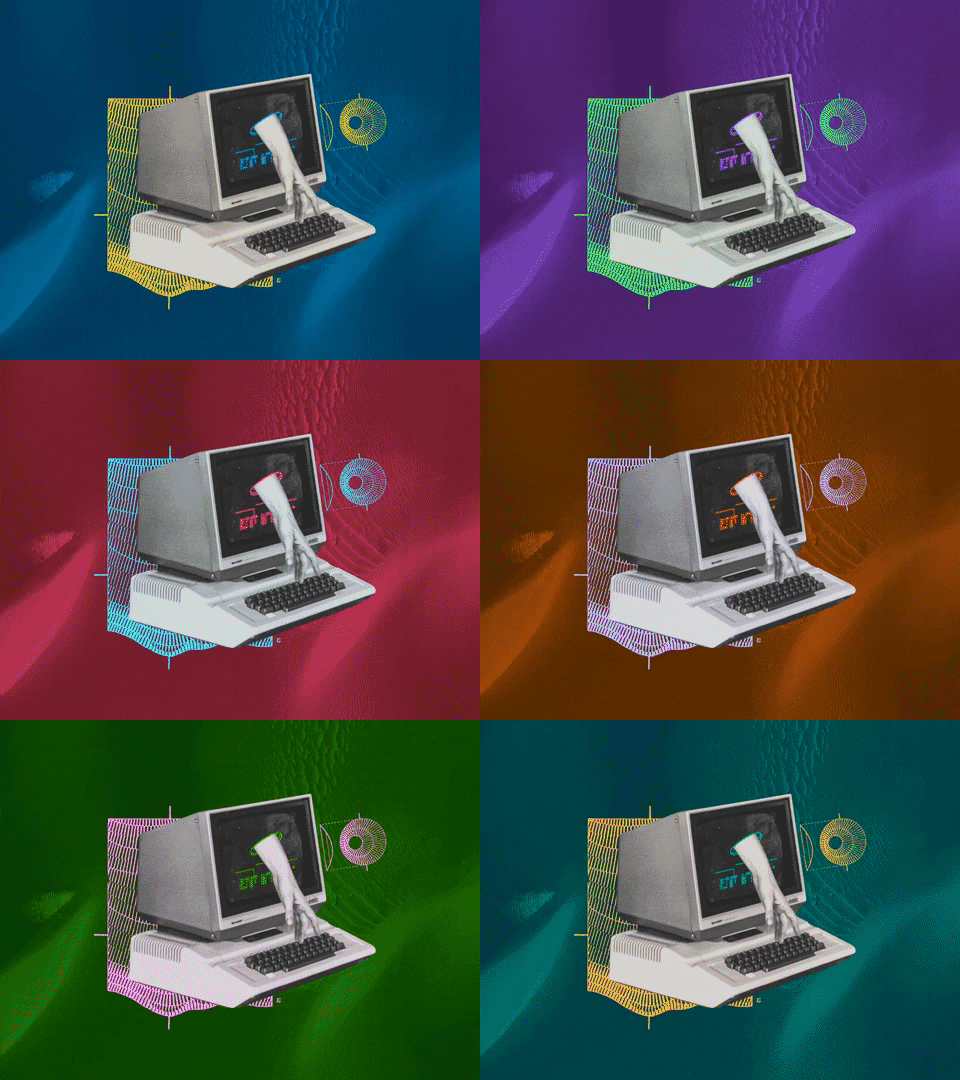
You get used to it after a while, thinking in the ones and zeros. The black and white of a corporate life, shuttled from room to room with the white, fluorescent lights and the beige cubicles of congruence and complacency.
I gave up my writing dreams the second I stepped foot into college. Too many guys in suits, too many scrub-wearing, smiley-faced blondes, and way too many tables set up in the student center telling me exactly why I should kill my past self. All it took was one look at an all-too-low five-digit number that called itself a salary, and I was scribbling my name underneath the sign-up sheet for the “Alliance of Undergraduate Computer Scientists”.
Four years later, I was unpacking a cardboard box in a cubicle on the tenth floor of Innovanta Technology, the company that Forbes magazine had named “the next Apple”. The company wired me in as an assistant programmer, a job that I was equally underqualified for and too right-brained for.
It wasn’t until about the third week of my employment that I was introduced to Marshall Keller, a younger man of spiky hair and outdated plaid waistcoats. We were paired up to work on the department’s newest software development project. Our interactions were silent, stilted, separated. At random times, I would glance over at him, and he would be hunched over his monitor, his face swallowed in the cloud of a green [ERROR] screen. He drank his coffee black and he kept a box of old CD-ROMs and floppy disks under his desk. Sometimes, when the work got tedious, he would rifle through them, extracting one and just staring at it for what seemed like hours. He was odd, to say the least, and I did my best to file away any quirks that should sound alarms.
But there was a night when we were the only two left in the office, when everyone else had powered off and gone home, and even from across the lab, I could feel his eyes on me.
“You really shouldn’t be here, you know,” his voice cut through the dimmed room.
“Hey, this wasn’t my first choice, either,” I came back, trying to present myself as friendly as possible. “A girl in a tech job is like a horse in a car show.”
“That’s not what I meant. The way you doodled during the department meeting, the way your reports read off like sonnets . . .” There was a beat as he took a step towards me, which I equaled with a step backward. “. . . You’re creative. Too creative. You’re in the wrong job.”
“Sorry to inconvenience you.”
“No, it’s what we need. It’s what this company needs. Some fresh new code.”
He didn’t say anything else for the rest of the night. I didn’t know if I was relieved or unsettled.
The night before the project was due, Marshall invited me back into the deep recesses of the labs. A cloud of smoke rimmed around his eyes, and you could get lost in them, how endless they were.
“There’s something wrong with the software,” he told me. He was quiet, pondering. “It’s the greedy algorithm I’m worried about. It’s too . . . mechanical.”
“What do you mean? It’s a computer, it’s supposed to be.”
He reared his head into the fluorescent lights. He scanned me down and up, down and up again. A man in a state. A man who knew something I didn’t.
“But we want to be different. We want to blur the line between the human mind and the machine. No one else is doing that.”
I stepped back.
“What do you mean?”
And he followed my retreat.
“But you . . . you have everything we’re missing . . . “
The man I knew was gone. In his place stood a virus of unshakeable intent.
“. . . a new code.”
It was my last night with blood. With flesh. With agency over a finger or an eye twitch. It was my last night being an assistant. It was my last night being human.
Even when the chips prickle when I try to move, even when the fluid feels cold against the inside of my skin when the cables send a transmission, I try to write a poem in my head. To keep some realm of humanity inside of me, in this monitor, pressed deep into the data. To remember the girl who wanted to write, who wanted to print words and ram her opinions into the heads of society.
But all that comes out now is the code, not the blood.
I don’t think anyone has even noticed that I’m gone. The stupid assistant, meddling in everyone’s business. What a relief she put in her two weeks. What a relief she found a fate greater. There’s a hole somewhere in this punctuated data that has made these words only words. I pick them apart with my hard-boiled malware and find them unrenderable. The letters don’t care for me anymore, and I have found that I have lost my way to care for them.
I watch while they work. The fan whirring in the back of the monitor is my breath, but they don’t remember who it belongs to.
But it’s not so bad now. I’ve found a rhythm in the reboots, in the uploads, in the refreshing. With every clearing of the cache, there’s a breach in my frame; it opens it further, until the ether of type taps in. But here it’s always dark, and the algorithm helps me think. Even if every input severs another part of me. Even if every thought is a fresh wound, open and gushing in the bytes.
It’s not so bad, to be a one-track mind. I never considered the community of a motherboard, or the embrace of a streamlined thought.
And you get used to it after a while, thinking in the ones and zeros.