

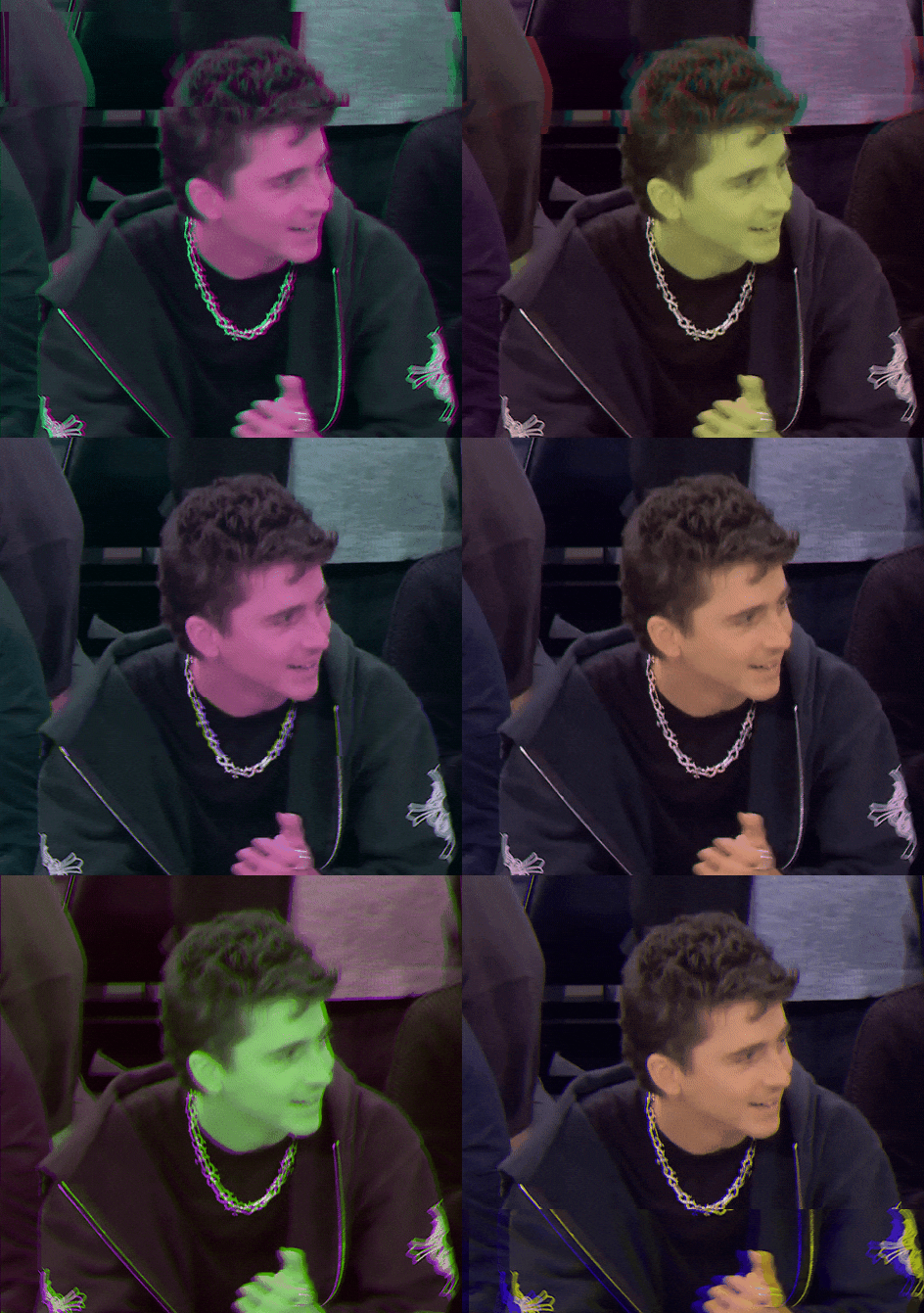
Timothée Chalamet barely notices the patch of darkness in the middle of the court. He barely registers the shadow, cast by nothing in particular, which is beginning to swallow up the light. He turns back to the play. It’s probably just a trick of the light, he thinks. A broken bulb in the grid above. A malfunction. A mistake.
He knows all about light; the way it can catch a face at a certain angle and transform it into an object of devotion. His girlfriend, sitting next to him courtside, understands it too. She is fluent in the language of incandescence, translated entire corpora of lightworks into shareable images. She has studied the sacred texts of civilisations devoted to light, first the worship of fire, then the stars and, finally, light itself, mastered in equations, pure and untroubled by time.
She has even begun the slow work of translating her body into light. Etherealising her being, she calls it, through the application of creams and gels, through prayer and meditation and now, at last, by removing the parts of herself destroyed by time, light’s sworn enemy, and replacing the broken cells with elaborate duplicates rendered in silicone, which is itself, she says, an emanation of light, quartz sand alchemised by heat, light’s brother.
The work of light never stops, she says and Timothée smiles and thinks, typical hot girl shit. Like tanning and astrology. He is reminded of the Egyptians, of the god Ra, of men on their knees worshipping the sun, and is pleased to partake of a parallel ritual, although he’s not sure whether he’s the worshipper or the worshipped. A high priest? A scribe maybe? Or is he a slave, back broken building pyramids to gods he doesn’t believe in, the gods of some shady executive, hidden in an office somewhere or locked in a cellar.
He prefers not to think about it too often. Of the things he’s almost seen. He is devoted to his craft, and his craft takes up all his time. All his conscious time. Because at night he sees things. Shapes cast on the wall of his bedroom. Women giving birth to children with talons and claws, pulling them out from between their legs and holding them up to the sky, triumphant. Holding them up to the light? But there’s no sun in these shadow plays. No lamp. No light.
He trains. He works. He tracks down old tapes of Brando, old footage of screen tests stored in dark vaults, protected from the light. He amasses reams of notes Brando took in acting classes. Fragments of wisdom from monologues by Stella Adler, which he wrote down in her studio on West 27th. Timothée reads them. Runs his fingers over the words. Commits them to memory. Then burns everything. The books. The tapes. No one else will ever see them. No one else alive will ever know what he knows.
He is a craftsman, he tells himself, and a craftsman is devoted to mastery. But still, he wonders, who is he doing it for? His mother adores him. His father admires him. His girlfriend is the envy of millions. Who is he appeasing with these games? He tells himself he is working for something greater. He must believe this. Otherwise, he would collapse. He knows that’s how it ends for so many in the business. How it ended for Brando. Brain pickled, reduced to reading lines off cards held just off camera. And even in that despondency, reduced to that pathetic act, he was great. Even as his star declined, flickered out, in those last moments before he was swallowed by darkness, he was colossal. Timothée longs to be greater. Longs to be a light for his age to steer by. A boat crowded with the lost, the suffering, the ugly and malformed and up above a constellation, his name, his twinkling eyes. His elfin chin, studded with light. And they will row their boat by my light, he whispers, row themselves over the oil dark sea, to unknown lands, to ecstasy.
And still the darkness grows. And still the shadows play. There are so many mothers, pulling things from between their legs, offering them to him. Children fresh from the womb, rudely subjected to the harsh glare of his light. Held out to him as he passes by, as if to say, what do you think of this child of mine young prince, can he be a star too? Can my child be admitted to your court of light? So many shapes, in the corners of rooms, shadows sleeping rough in crevices, beneath staircases, inside the walls, hunched over in the back row of editing suites. He tries to tell his girlfriend about them and she just shrugs.
In the middle of the court the shadow grows. It’s hard not to stare. Timothée tries to focus on the ball, the towering men, their long limbs, their coloured jerseys. Tries to meditate on the orange shape passing through their legs, moving from hand to hand, rebounding off the shining surface of the court. A chance. A ricochet. A buzzer. The illumination so absolute, nothing is hidden. Everything outlined perfectly, nothing is amiss. Except the shadow.
Among all this light, the shadow grows, warping whatever it touches, drawing things to it, water bottles, fluorescent sneakers, hotdogs, ticket stubs, diamond earrings, gold chains, holographic sports cards, hairpieces. Then parts of players, arms and legs, bent backwards out of shape. The crowd, courtside, chanting, changing. His girlfriend too. Stretched beyond recognition. She is murmuring something; he tries to make out the words. How come it took you so long to notice babe?