

“That,” Martin says, “is the World’s Largest Rocking Chair.” And it actually rocks, he says—it wouldn’t be eligible for the designation otherwise. He gets this from the plaque out front, but relays it to his son with the authority of someone who knows everything about everything—and does, in the eyes of this boy who has learned from him to fish, to throw, to separate sunflower seeds from their shells with his teeth.
They stand in the shadow of the World’s Largest Rocking Chair.
Martin looks up at it. His son, Ben, looks up at him.
…
As they pass Springfield, Martin talks about Abraham Lincoln.
When they stop in Hannibal, he talks about Mark Twain.
For long stretches, there’s nothing, and so he talks about the songs on the radio. “Bob Dylan wrote this one,” he says. “And this one, this is Ronnie Wood from the Stones singing.” At the percussive first notes of “Waterloo Sunset,” he says, “Your mom and I used to put this record on and sit on the roof listening to it at night.”
Martin looks at Ben to see how much of this he’s taking in.
But Ben is looking out the window at the nothing, the nothing that seems to go on forever.
The midday, mid-country July heat overpowers the air conditioning.
Their shirts stick to their backs and to the leather seats.
The singer sings, “Dirty old river, must you keep rolling, flowing into the night?”
…
Martin and Ben arrive after dark.
The house smells of tilled earth. Flies buzz into the filthy window screens and the rotating fan. Raymond is already there.
“Good progress,” Martin calls out, by way of hello.
“Yeah,” Raymond yells back, emerging from the clutter of their father’s room. “Couldn’t have done it without you.”
“Sorry,” Martin says, and embraces him. Raymond is stout, like their father. Martin has the lanky figure of their mother in old photographs. “You know how it is.”
“Of course,” Raymond says. “I know how it is.” He turns to Ben. “And you—getting tall, kiddo,” he says. “You’re looking more and more like your old man.” He makes himself Ben’s height and says, as if divulging a secret, “No offense.”
…
They sit on the porch, looking up at the stars. Martin and Raymond drink their father’s whiskey. “He had good taste,” Raymond says, wiping bourbon from his mustache.
“He knew his stuff.”
They sit there silently for a while. Then, Martin leans over to his son and points to the purple sky at Altair, Deneb, and Vega.
“Summer Triangle,” he says.
…
This about the Summer Triangle—it has, like the business with the World’s Largest Rocking Chair, come to Martin second-hand. His father had been the one with the old reference book of constellations, the telescope in the barn. Martin wonders if the telescope is still there, and goes out first thing in the morning.
It is a sunny morning. The heat is already drawing the dew from the grass, and a rafter of wild turkeys has convened in the shade of the trees that overhang the edge of the field. But inside the barn it is as dark and as cool as a catacomb, smelling of dampness and decay. There is rusted farm equipment, old signs, boxes stacked everywhere. Martin thinks, “Jesus.”
When he finds the telescope, it is dusty and cobwebbed. But it works. He takes it outside and looks through it at the daytime sky, where the moon is a ghost against the bright blue.
…
When Martin gets inside, Raymond and Ben are sitting on the floor amid a scatter of Polaroid photographs.
“That was my Uncle Kurt,” Raymond says, looking at one. “And this was me and your dad at Niagara Falls, the summer grandpa took him and me all the way up the east coast to Portland,” he says, holding up another.
“Who’s this?” Ben asks, handing him one.
Raymond holds it close to his face, squinting.
“I think that’s Loretta,” he says. “That’s Aunt Loretta.”
Martin walks over, takes the photo, and squints at it, as his brother had. It’s a washed-out image of the old house. Their father is sitting on the stoop, a bottle of beer between his gnarled hands. Their mother leans on the railing beside him. Leaning against the screen door, with a bee-hive of hair and white cat-eye sunglasses, is another woman.
“That’s not Aunt Loretta,” Martin says. “That’s Mary Schaeffer. She lived down the street.” His mother and father had been friends with the Schaeffers. He was too young to remember them well, so of course Raymond wouldn’t have recognized her. But Martin could vaguely recall Mary and her husband—Carl? Chris?—being by the house Saturday nights, drinking and playing cards. “Mary Schaeffer,” Martin says again. “It was probably Mr. Schaeffer who took the picture.”
…
Martin and Raymond divide everything evenly, as outlined in the will. They each get half the money, half the ashes, half whatever they can get for the house. The only thing Raymond wants for himself, he says, is the car, an ‘87 Firebird. It needs a paint job and some repair, but their father loved the car—and, Raymond says, “I love that car.”
“Maybe we ought to talk about it,” Martin says.
“What do you call what we’re doing right now? I didn’t say I’m taking the car. I just said I’d like to have it.”
“No one’s stopping you,” Martin says. “I just want it known that I love that car, too.”
…
All the furniture can go—except, they decide, for the coffee table, which their father had made himself from the trunk of an old oak the county cut down out front when they were kids. The legs are uneven, and the table-top is set at a crooked angle. But their father had an innate sense of craftsmanship, and when Martin runs his hand over the lacquer, tracing the creases in the wood, he can feel his father’s wisdom in the carpentry.
“Durable,” he says, testing it with a shake.
The books, the films, the art on the walls—that’s another story. This, they go through and divide into piles: Martin, Raymond, and to-go. Martin says they must be mercenary, and for a while they are. But Raymond’s pile gets bigger and bigger and begins to merge with the to-go pile.
“Don’t,” Martin says, “be sentimental.”
…
Martin comes back out to the porch, after calming Ben down from a nightmare, and pours the last of the bottle’s whiskey into his glass.
“Did I tell you about the dream dad told me about before he died?” Raymond says to him.
Martin shakes his head.
“Dad said that, in the dream, he was chasing after Grandpa Edgar to tell him something,” Raymond says. “He said grandpa was running, and that he was running after him, and he kept saying, ‘Stop,’ but Grandpa Edgar just kept running. And he kept chasing him like that and chasing him, until finally Grandpa Edgar stopped and said, ‘What? What is it? What is it you have to say to me?’ So dad opened his mouth to say whatever it was, he told me,” Raymond says. “But when he went to finally speak he was too out of breath to get the words out.”
…
The realtor is half an hour late.
“So sorry,” she says, before she’s even out of her car. “My last showing ran over. Young couple, first-time homebuyers—sweetest people ever, but just cannot make up their minds.”
She shakes Raymond’s hand, then Martin’s, and Martin thinks about what she will tell whoever she meets after them: Nicest guys ever, but just couldn’t get the words out.
…
Raymond jingles the keys and says, “Want to take it for a ride?” Martin looks down at Ben. They nod at each other, then at Raymond, and they all get in the Firebird.
It’s cramped inside. It smells of dust and old smoke.
“I can’t believe this thing still runs,” Martin says.
“It’s in better shape than it looks,” Raymond replies. “Those last couple weeks here, taking care of dad, I’d come out and fool around under the hood for a little while, just to pass time. Thing’s got a hell of an engine on it. Watch.” He guns the Firebird, smiles at Martin and Ben. “How’s that for power?”
“You can launch us into space with this thing,” Martin says.
Raymond eases up on the gas. Martin turns to the window, the wind rushing up on his face, and looks out at the fields of soy and corn and horses and cows, and wonders if he will ever come back to this familiar place again. What reason would he ever have now? They pass decrepit barns, silos and hunting stands, the nothing that goes on forever, until they come by a country cemetery and Raymond turns to the back seat.
“Want to drive?”
…
Ben sits on Martin’s lap, steering the car along the narrow, winding cemetery road, while his father works the pedals.
“Ten and two,” Martin says. But it looks unnatural, and Ben keeps moving his hands to the sides of the wheel, the way he has steered every toy wheel he ever got behind.
“He’s got it,” Raymond says from the passenger seat. “He’s doing great.”
And it’s true. He’s driven millions of miles in his mind, but now it is the real thing—the biggest thing he’s ever handled—and he’s handling it, his face is fixed in concentration, his hands tight around the wheel, saying nothing. Through the window, Martin regards the headstones, the chiseled names and dates that suggest stories they never tell:
Stanley R. Roach, 1888-1946
Robert T. Monson, 1913-1992, and Deborah H. Monson, 1921-1974.
Jefferson Riedell, 1950-1951
Richard Robert “Big Bob” Keller, 1909-2004
An American flag on one. On another, a golf club and a plaque: I’m finally six under! By another, a woman is tending to the long grass around the stone with kitchen shears, as though giving a haircut. She smiles with half her mouth when she sees the car go by, with Ben behind the wheel, and wipes sweat from her brow with her gardening gloves.
…
Martin loads the bags into his trunk.
“Take it easy,” Raymond says.
“Yep,” Martin says, hugging his brother. “Take care of yourself.”
Ben climbs into the passenger seat, the leather hot with the midday, mid-country July sun. Martin sits, turns the radio on, and pulls backward out of the long gravel drive. Raymond waves from his father’s porch, and appears, from a distance through the windshield, to be his father. Martin lingers on the image for a moment, and then turns the car onto the road.
…
“Shit,” Martin says, pulling to the dirt shoulder.
He gets out and looks under the hood. “Shit,” he says again.
“What’s wrong?” Ben says. He’s out of the car now, too, standing next to his father. “Is it okay?”
Martin looks at his son, then back at the car, trying to find the answer inside this confusion of machinery, inside himself.
“It’s not okay,” he says finally. “But I don’t know what’s wrong.”
…
The mechanic says, “I’d hazard that it’s the alternator, but we won’t be able to say for sure until we get to it tomorrow.”
“Tomorrow?” Martin asks. He and Ben have been towed into town.
“At least tomorrow,” the mechanic says, pointing at the plastic clock above the counter. “Our customers enjoy a discounted rate at the motel by the exit.” He hands Martin a flyer. “And,” he says, “at the diner across the street.”
Martin is quiet through dinner—country fried steak for him, grilled cheese for Ben—and he is quiet when they get to their room at the motel. He can think of nothing to say. In the silence, he and Ben fall asleep in their queen beds, above the covers, in their clothes. Martin dreams that they are back at the old house—all of them, Martin and Raymond and their father and their mother and the Schaeffers, but also his wife, and Ben, and they are playing cards, and his father makes a telescope of his hands out the living room window and says, “Altair, Deneb, Vega.”
…
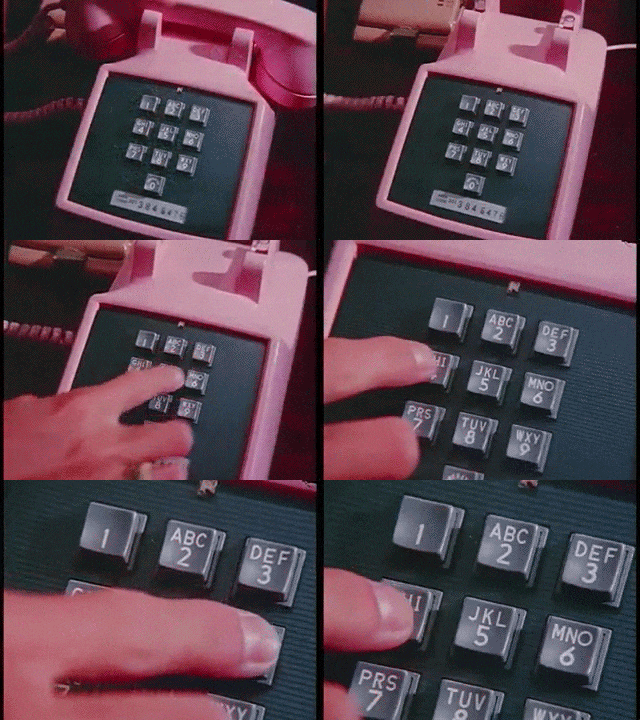
Martin wakes up in the dark with the back of his head damp. He thinks of his father. He thinks of calling his father’s number. He doesn’t know why. But he feels compelled to do it. Before he knows it, he is pressing the numbers into the motel room phone; the muscle memory is surprisingly fresh.
He has never dialed his father’s number without expecting him to answer, and so he almost expects him to answer. Instead, there is a tone, and then a woman’s voice.:
“The number you’ve dialed is no longer in service,” she says.
Martin hangs up slowly. The light from the courtyard pool is dancing on their ceiling, and he follows it to the window.
Down below, in the water, are three kids. They can’t be more than 18 or 19, but they’re drinking beer. They are laughing at something.
Martin checks to make sure Ben is asleep, then he eases out of the room.
“Hey,” he says, as he descends the stairs to the pool deck.
“Were we making too much noise?” the tall blond boy asks, setting a Busch can on the ledge.
Martin grabs a beer from the box—wet with condensation and pool water—and cracks it open. He drinks deeply from it and says, “Look there.” He points to the sky. “The Summer Triangle.”