

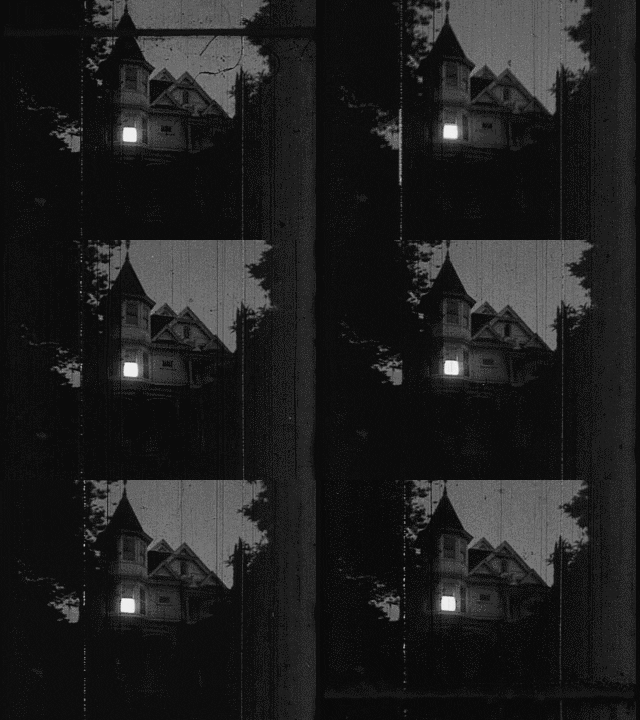
Welcome to your own little home, dear, what was once mine— the hill it sits on, the grass and the worms, the one good sunny patch in the back that’s fit for growing vegetables, the slight slope to the forest line and the wide stump in the front of it there, where mushrooms bloom on the side that is damp and shaded; the steep-pitched gables, six of them, the wavy glass windows beneath and their sills and the mourning doves’ nests that accumulate there; three beds in their iron frames dressed in chenille and linen, one of them holding the impression of a woman who slept very well in one spot; a wide hearth in the front room and the orange cat, Shax, who resembles an overturned bowl of butterscotch pudding, sleeping smugly close to it, and a smaller fireplace in the kitchen, hugged in by brick, big enough for a soup pot; a little copper tea kettle that no longer whistles, but makes a chugging, bubbly sound, like an old dog dreaming; a lamp in the hallway, shaped like a woman, a water-bearer, and its pink silk shade (torn); a rotten sense of foreboding—
Let’s start with her as she lived. Her hair was frizzled, always, and her hands smelled of garlic, lavender lotion, and the pages of old books sick with dust mites. She drank Coca-Cola for breakfast and gin (cold) in the afternoons, preferred Marlboro Reds, wrote novels about chopped-up girls, penniless orphans, and men who should know better, and simply hated Capricorns, body odor, unduly loud laughter and the people who assured those laughers that the noise was charming. She spent all the time she could in her garden, under a wide-brimmed straw hat, and when a day contained both rain and sun, she’d mimic her grandmother in remarking, “the devil is beating his wife again.”
Before it happened, and I mean in the couple of years before, she’d reached the age where she no longer took pictures, only looked at the ones she’d already taken.
—an iridescent grub of light wiggling in from the outside of your vision and bringing with it an ominous throbbing in your temples; a slippery chill down your spine that even the fire in the wide hearth can’t warm; footsteps, anxious, pacing in the dark of the hallway; lights you’re purposely left on flicked off; the keys of the typewriter on the desk in the library, rapid like gunshot, followed by the satisfied cracking of knuckles; a whiff of tobacco, the shadow of a curl of smoke; waking to your hair braided, tied to the iron filigree of your bed—
How do I explain this to you? That tree at the front of the forest line that is no longer a tree but a stump where a tree once stood? If you wink one eye at and then the other and you do this quickly back and forth, the tree line blurring, you will begin to get an impression of that tree, the height of it like the rest, the leaves baking in the sun or shaking off the rain, the shade its limbs provided, how something can be there and not be there, all at the same time.
—a craving for gin (cold); in a sterling frame on the mantel of the front room, a picture of her facing the camera in a wide-brimmed, straw gardening hat, with a gap-toothed smile and me, looking only at her, my lips shaped in a question I’m sure she didn’t answer; the tendency to trip on the hall rug (Turkish, moth-chewed) which, yes, you just straightened but is bunched up again, and the sooty, bulbous stain it tried to cover—
She doesn’t get angry about it as often —but when she does, you’ll feel it in your back teeth. Have you ever been on an old wooden rollercoaster, your jaw clacking with the unseen force of it? It’s like that. Her sadness too—pinches at the roll of skin under your bra. Her loneliness? The smell of someone else’s hair, someone else’s skin, on your pillow.
What is she now? As a child, I felt I left a piece of myself wherever I went (park benches, diner booths, movie theaters etc.) and that eventually I would be full of holes, and then at the end of it all, those pieces would come back to me, descending like a plume of locusts. Maybe that is how it works and she is made of that, atoms taken apart and assembled differently.
She prefers to think she is made of that feeling you sometimes have as you slip into sleep of falling from a great height.
It’s important for you to know there is no answering grief, even with the reminder of love. Would you remind someone drowning in the ocean of the beauty of the beach?
Take care of her for me? And Shax, too. He prefers her, even now.
—a wide-brimmed, straw gardening hat with a dinner-role sized hole in the crown colored the old red of dried-up strawberry jelly, stuffed in the hall closet behind coats and weights and a broken Bissel vacuum cleaner; a peg-board in the basement holding screwdrivers, a rubber mallet, wrenches, and the shape, the outline of a claw-hammer (missing); a fury of whispers and raised eyebrows at the grocery store, at the library, at the post office; a silent doorbell on Halloween; a bus that comes weekly, white letters on the side of it spelling MURDER TOUR, and the people who squeeze in it together, their thighs touching, sticking to each other, the spit pooling in their open mouths, their eyes flicking between your own little home and the gleeful man in the black suit with the wide lapels, and a microphone in his greedy palm, and their lickerish desire to know the answer to a story with an unknowable ending—an unknowable ending.