

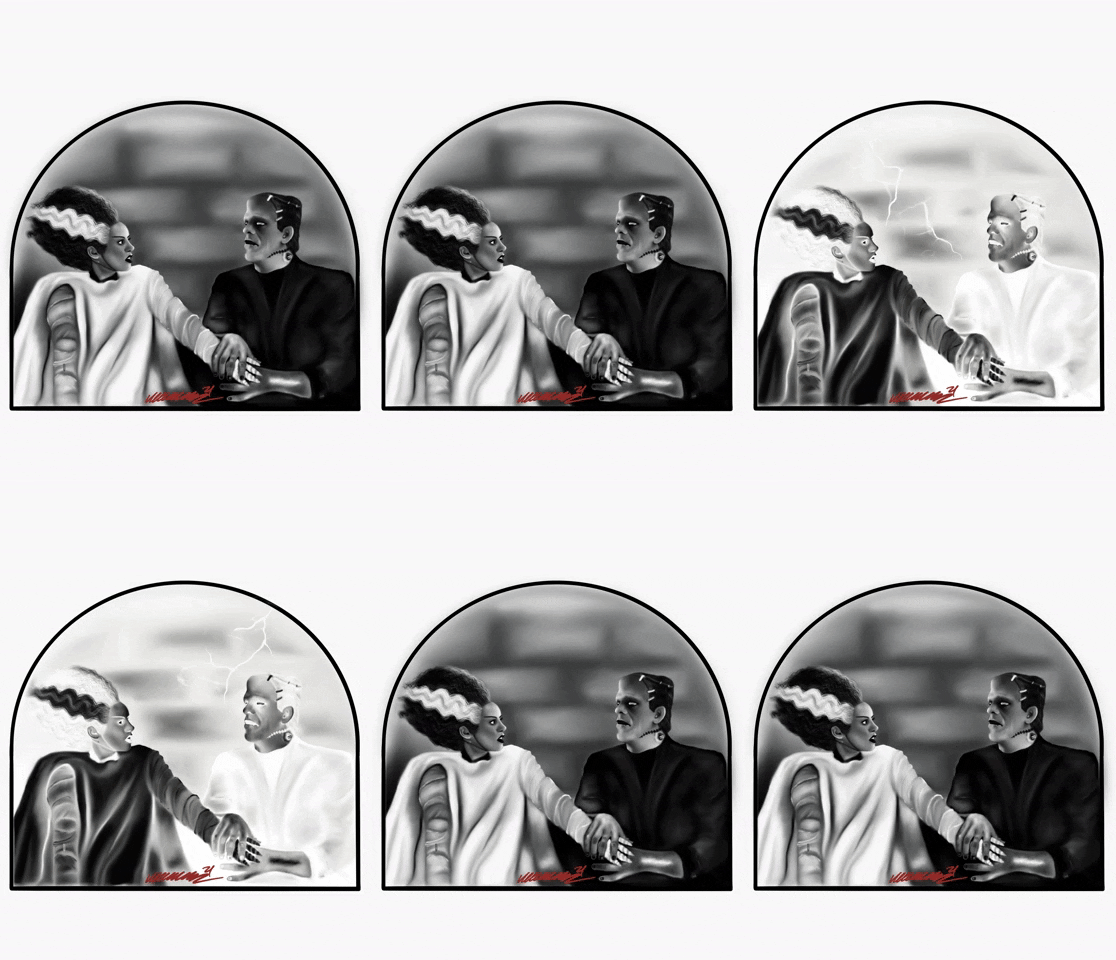
In the version where Dr. Frankenstein lives, and lives forever, he finally makes a bride. She is not cobbled together from body parts, and she is not made to marry his monster. The year is this year (plus a zero) and she is the cybergirl.
The cybergirl is made for a customer who explains in an email that real girls don’t like him because they just aren’t programmed right. The man requests Dr. Frankenstein build him an artificial woman—one who wouldn’t have bit the apple in Eden, but might bear such a symbolic fruit on her gray-hued exterior, trademarks permitting.
Dr. Frankenstein accepts the commission with enthusiasm. He’s so excited he passes out. His assistant has to break the Dr.’s phone screen and give him direct contact with the circuits to jolt him back to life.
But how will I check my email? is the first thing he says when he regains consciousness.
Someone is sent to buy him a new phone.
*
The cybergirl is strung together. Frankenstein forms her with wires and circuits, with smooth metal plates that form peaks and plains. In her hollow skull he inserts a brain too fast for its own good; it is always overheating.
It takes Dr. Frankenstein five days to complete the job. He beats God’s record for creating Everything, but not his record for creating Eve; he tells people, anyway, he beat both. His assistant, the press, the happy customer, even the priest who officiates the wedding between the bride and the customer in the workshop, are too scared to correct him.
You may now kiss the metal bride, the priest says, and Frankenstein watches the customer do so, and pull back and rub his lips, which are burned.
I told you she was hot, Frankenstein says. Caveat emptor.
*
Frankenstein’s monster was the original cybergirl. He was a being strung together from fleshy pieces, sloppily stitched; disgusted by himself, and horribly lonely; yearning, and rageful in his yearning; but his speech was so eloquent, and his pain was so beautiful, and everyone said he rattled the bars of his cage with such style.
If Dr. Frankenstein were put in a cage, he would rattle the bars at such a speed as to cause them to catch flame, he says. He would emerge from said flames reverse-baptised, ready to burn the world on a stake. But this is a silly hypothetical, he adds. No one would ever put him in a cage.
*
The cybergirl (married) is man-made and sparking, ready to catch flame. She aspires to self-immolate in open-air spaces, to let her body leech sulfurous smoke that chokes the whole globe. She has a fear of doctors. Not of needles, glove-snaps, prodding. Not of bacteria, nor anesthesia. Only of the degree-holders in the hospital, clutching their knives, waiting.
The cybergirl dreams of violence, as Frankenstein’s monster did. But said violence is not directed toward others. It is directed toward herself. She has a Möbius Loop, three chasing arrows, etched on the bottoms of her footsoles: the universal symbol for recycling: You will be unmade and made again.
When one is born recyclable, one is deprived of their right to ever live. It is simply this: your parts will be needed again elsewhere, and you are no Ship of Theseus. You are the ingenuity that comes between recyclings, temporarily enlivened to answer demand; mash-up mad-dog of ethical slumber; the brain-rotten rant of a scientist who thinks yearning is wanting and getting what you want, when to the cybergirl it is wanting and knowing you will never have, not even a speck, a taste, a chance.
*
An email (unanswered) to Dr. Frankenstein (on vacation) complains: my bride, her breath, it always smells like smoke.
*
Frankenstein (Victor, Dr., college dropout, graveyard robber) once yearned for a peace he could not have. He took pieces of people (deceased) instead, performed unholy acts, had nothing good come of it, anyway.
Dr. Frankenstein ripped his female monster, a half-made bride, to shreds. When he created a cybergirl, he knew he would one day rip her to shreds. He created a monster and he let him get away, knowing the world would do the work for him, and the monster would rip himself to shreds.
*
Years later, people call Frankenstein’s monster (myth, by then) Frankenstein. Wait, the Dr. tells them, you think Frankenstein is the monster’s name? How embarrassing! You’re thinking of Frankenstein’s monster. Dr. Frankenstein is the man who made the monster. He’s me. And I’m not the monster.
(And if you make a monster, what does that make you? reads another unanswered email.)
*
And just as a car dashboard flashes a check-engine light you try to ignore, a burnt-out bride lets her eyes shine so bright they’re blinding to look at. A husband looking to do a trade-in must fumble his way to the dealership in the dark, and there relinquish all his worldly goods.
I now pronounce you divorced, Frankenstein’s assistant tells him. The priest is long gone.
*
Frankenstein (doctor) versus cybergirl (monster), in the workshop, in the middle of a lightning storm:
I’m not ready to be recycled, she says.
Dr. Frankenstein lifts his chainsaw.
I’m not ready to be unplugged, she says.
He loves the chainsaw’s teeth.
The cybergirl could bite Dr. Frankenstein’s head off; she too is a machine with teeth; but, ever one for an argument, and adopting, too, the monster’s eloquence, she says: I present to you—
He loves the shriek—
the untrimmed ends of my surgical sutures, the wires meant to be pulled—
of metal on metal—
to unravel a body back into bleeding, the loose threads, mental and physical, that bind every being together—
My iWoman, he says, my Apple girl, we have fallen so far from that tree
of knowledge of good and evil—
and I dare you, she says, O, monster, I dare you to pull.