

(an informal report delivered to the New York Folklore Society at Binghamton University, 13/9/2015)
The date was August 9th, 1998. A call comes into the emergency call center at 9:04 pm. Patty Silvan picks up and the following is a narrative derived from interviews about that night:
If it hadn’t been confessing to the gruesome murders of “several poor goils”, then Patty’s heart would’ve broken for the weepy male voice speaking in faint, stuttered mumbles on the other end. The one pleading to her that they must stop him because he couldn’t stop himself, that he was sitting in a phone booth and he was holding a gun to his throat. Several times, Patty had to ask him to speak up.
“What’d you say, darling?” she asked.
“Please come,” he said, “I don’t know if I’ll go to heaven if I commit suicide. I don’t think God will forgive me of killing myself.” Patty almost said to the man that God would forgive anybody, but her throat clenched up before she could. For some reason, her body wouldn’t let her say those words.
.ii
The following narrative derived from police and coroner reports as well as public records and interviews with parties familiar with Lipmann family:
Adrian Lipmann would quietly leave the apartment when Francis, his mother’s on-again-off-again boyfriend, came by. He preferred not to witness Francis (rarely sober) hitting her in what had seemed at first like an involuntary act as if his mom’s timing had been poor and she’d ambled into the room just as a slap was occurring.
“The gesture of the slap is a metaphysical conceit, really. Who knew why it existed and what purpose it truly served? Existence would need to be broadened out to infinity to discover it,” Adrian waxed. He said that he imagined that it had originally been meant for something else, but people kept walking into rooms at the wrong moment. However, it soon revealed itself as “just one more horrific node of an evil demi-urge’s riotous play upon [him]”. Confirmation even before the age of so for Adrian: there was no God.
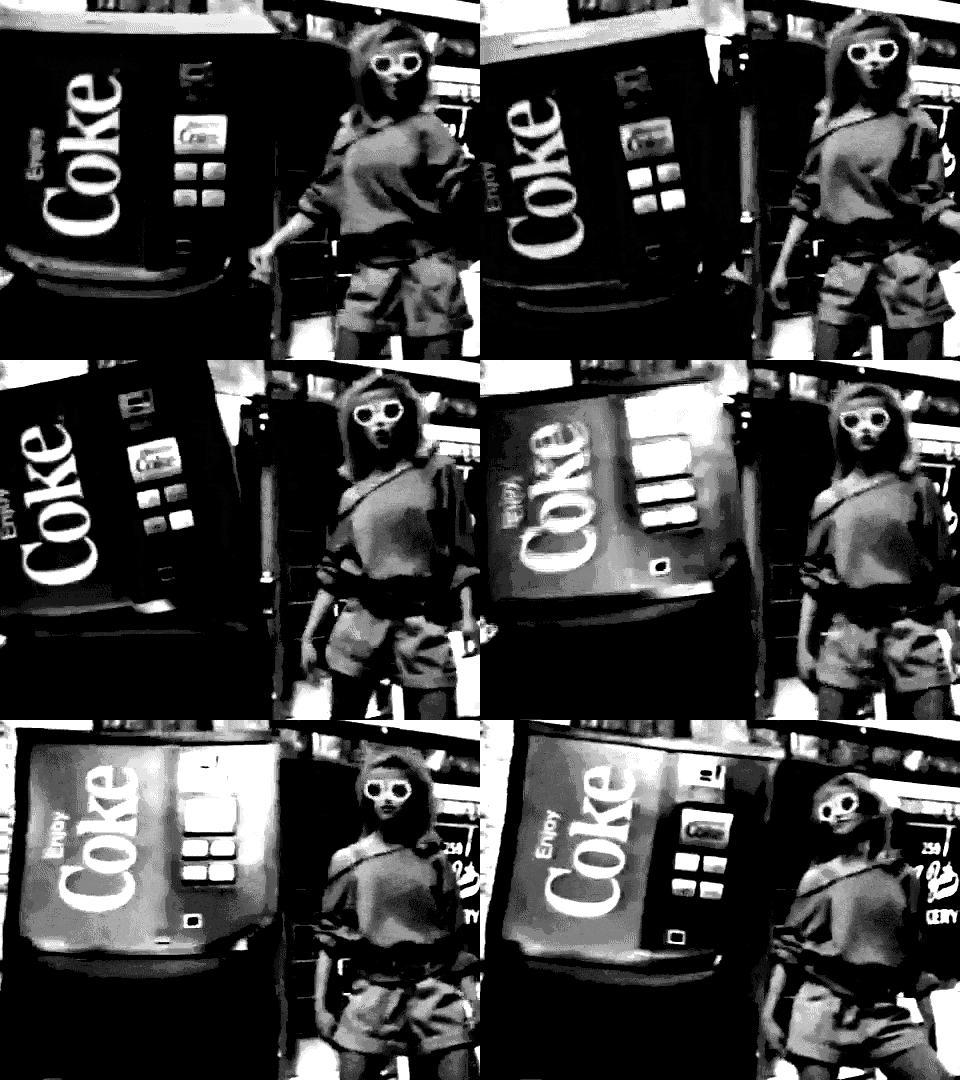
Adrian often rode his bike to The Coke Machine (as it was referred to by long-term residents) sitting in an otherwise uninhabited, derelict section of the city: the West End. Down the street there was a laundromat, a McDonald’s and a coffee shop where all the seats were decorated in tie-dye blankets. All the streets in the West End had German names: Schopenhauer, Goethe, Bach, Mendelssohn, etc. The result of ancient German immigrants’ nostalgia for their homeland. The Coke Machine was on the corner of Bach and Nietzsche. It had been there for as long as he (or any other child) in the neighborhood could remember. It was never empty despite the fact that he (or any other child) had never seen a Coke truck in their neighborhood refilling it. They never questioned its abundancy.
.iii
Binghamton, New York was known for a particular brand of working-class surreality. Its history can be summed up as a business plan. It was founded by wealthy entrepreneurs from (through birth or marriage) the Bingham family who created their own societies. Money was their object of religious veneration. They filled their factories with uneducated immigrants and poor Americans. They allowed grandiose mythologies to surround them (interestingly, an attribute of a growing number of fascist dictators popping up around the world at that time). Seeing the incredible magic that money could wreck upon the physical environment, there arose among the denizens of Binghamton certain deific notions about the founders. When these deities of the Bingham family moved on, the angel of history did its dirty work. It was incomprehensible to those who were caught in its rampage. Streets, buildings, whole neighborhoods emptied or rendered unto torpor.
Someone who doesn’t believe in the lore of The Coke Machine is invited to go to “IBM town”, a vacant section of land over half the size of Binghamton. A small town that had once been its own district. Now vacant after the technology company’s sudden departure. (Many residents, once they’re comfortable with you, will point out the similarity between the Google Maps images of the former IBM site and satellite images of Area 51…) People in Binghamton can still sing the company songs. At a Bojangles’ on Hegel Street you can hear a barbershop quartet of former employees perform a medley of IBM songs on Sunday afternoons after church. It’s as eerie as it is heartbreaking. To many in Binghamton, this was far more surreal than “The Coke Machine”.
.iv
For better or for worse, it is my opinion that the existence of The Coke Machine somehow reversed Adrian Lipmann’s opinion on God. Although it’s more like that it had never actually changed in the first place, but only sat in hibernation waiting for the slightest reason to push it back up to the surface. (Who really knows these things though?) Regardless, Adrian believed that there was a God and that He did magical acts as proof of his existence. He’d never been to IBM town. His friends told him not to ride his bike through there after three in the afternoon because it was haunted. (There were conflicting theories about the genre of specter.)
v.
Narrative derived in part from police and hospital records as well as my own meditation upon the event for the past five years:
If it hadn’t been for their disembowelment (with particular focus on removal and dissection of the uterus) and murder, the six girls (or “goils” as the killer’s accent maintained, although “girls” is a loose term as the youngest was thirty-four) had been given manicures, pedicures and their make-up had been done so that it seemed that the red stringy mess of their abdomen was just another cosmetic addition.
Patty Silvan had attempted to keep the caller on the phone as long as possible. She had held him in conversation as she heard the muffled song of the police sirens beneath the man’s soft, teary voice cut short by a sharp crack and then a dial-tone seconds later. When she inquired later about what had happened they said that the suspect, one Adrian Lipmann, had shot himself in the stomach. Then, proceeded to widen the wound until he was able to grip his intestines and methodically pull them out of his abdomen “like a small child teasing yarn of out his mother’s knitting basket”.
vi.
What many suppose urban lore, a mysterious self-regenerating Coke machine in New York’s Southern Tier is an actuality that as far as long-term residents can confirm has been on the same corner, consistently refilled, for over fifty years. Retired Police Officer Alan Brady, a former IBM employee as well who still hums company songs in the shower, points out that there is a spooky, almost supernatural aura about it as, he states, “every so often you’ll see it ‘suck’ a kid in and when it does things don’t go well for ‘em…I mean, you’ll see ‘em dry up and put themselves outta the world somehow – it ruins them. But it only picks one…almost like it has to. Every so often…every couple of years…just what I’ve noticed, you know…”
Officer Brady is tight-lipped about what exactly he means by “dry up” and “put themselves outta the world”. He won’t elaborate. One thinks that he fears some sort of cosmic retribution for violating a metaphysical tenet of The Coke Machine’s unspoken agreement with Binghamton. Adrian Lipmann, by the way, died in urgent care. His abdomen looking like a battered piñata. A stranger might look at him and speak that time-honored cliché, “You just never know sometimes”. That’s true to an extent. No one knows anyone and the world is full of horrific deeds without a thesis. But that’s also a lazy statement. A dangerous statement. It seems to cast people (to clarify, certain kinds of people…) as time bombs, as domiciles of malevolent spirits. These kinds of people, it seems to say, are always to be found in poor communities. Their skin is darker colored. And if it is not darker colored, then their attitude (their soul, perhaps?) is darker. They have a greasy sheen to their humanity.
But in Officer Brady’s statement we find a different approach. The Coke Machine, if we are to assume it is a metaphysical object (and we should as evidence indicates as such), points toward the fault being not with people but with a larger power. Is it God? Perhaps. All things could be the fault of God. God could be evil. Or, the fault could lie in something that looks like God. That dresses as God. That acts as if it is God. Worse, this something (or someone) could think that it, all along, was perfectly justified in thinking and acting as it did. If I may be so bold, I propose that such exertions of force into the world are the gesture of an antichrist. One of many.
Perhaps you doubt such a statement. Perhaps you’re not a person of faith. Even if you aren’t, what I’m saying is not a matter of belief and more of a matter of physics. Do these exercises of power, exertions of force mentioned above transfer into inanimate objects? Technology such as computers or factory machines have been known to exhibit human emotions and characteristics when brought into direct contact with such. Could a machine be evil? Could The Coke Machine be possessed with something that was unleashed on the earth by the Bingham family’s frivolous expressions of power?
I leave these questions for the Society to ponder in their next meeting.
Best,
Brennan Burnside