

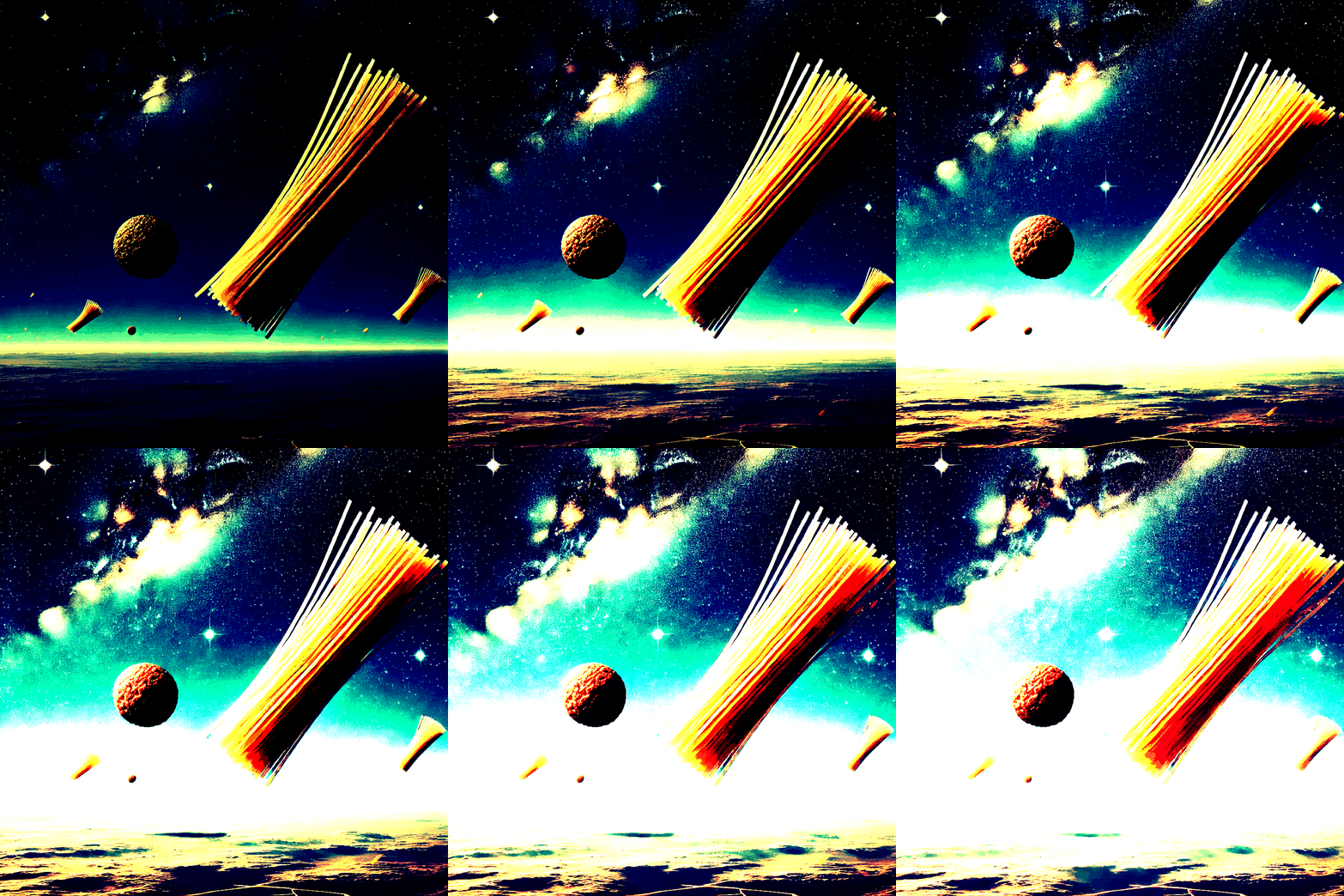
When you go through a black hole, your body turns to spaghetti. It can’t withstand the extreme gravitational pressure, so it gets stretched long and thin—a thread of light reaching all the way into infinity.
“This is all theoretical,” my dad said, wiping flecks of marinara from his beard. “No one’s ever been through a black hole.”
That was the last time I saw him.
The second-to-last time was when I was nine years old. Front row seat at a play he wrote—close enough to drown in its glow, yet too far to see myself sparkling within it. I was excited to be in the front row—like it meant I was somehow important—although I will admit to feeling a pang of jealousy when the curtains opened and I saw Dad looking all misty-eyed as he watched his creation spring to life before him. The thought crossed my mind that I, too, was his creation—an extension of the same impetus that brought this play into being—but by that point I was already aware that I’d never inspire the same sense of awe.
I was only nine, but already knew I wanted to be an artist—either a musician, or a painter, but with notes that behaved like colors or colors that behaved like light. When I was eight, my dad told me that synesthesia was a divine gift that enabled those who had it to see beyond the veil of reality and into the infinite. That was the only indication he gave that I might be like him. Mom says I’m not, and that’s a good thing. On the surface, she’s probably right.
She was bored by the play, but I wasn’t. It was so visually arresting it grabbed me from the start. The lead actor was dressed head to toe in mirrors cut to various shapes and sizes. I was close enough to see his makeup—eyes caked in glitter that ran down his cheeks, which were flushed from all the talking and flailing and screaming he was doing. His character was very upset that no one was listening to him—the other actors were bickering so loudly it was impossible to hear what he was trying to say—meanwhile I was caught up in the way the mirrors caught the stage lights and splintered them into shards of color, stabbing blindly at the darkness like miniature fireworks.
The next fragment of memory I have is of the man writhing on a wooden cross, which was positioned in front of a massive, multi-hued light that was flickering so rapidly all the colors blurred into a piercing iridescence. A lady a few seats down from us stood, loudly complaining about her epilepsy—shielding her eyes as she left.
The other actors were pelting the man with rocks. I think the rocks were real, because as they collided with his outfit the bits of mirror shattered into even smaller fragments, gradually revealing his naked body underneath. I was paralyzed, unsure whether to laugh or cringe, stare or look away. Mom was aghast—pulling on my arm and telling me we needed to leave—now. I held my ground.
“Leave her be,” Dad hissed. “It’s art. She’s old enough to handle it.”
He held one arm as my mom pulled the other, and in the middle I could feel myself stretched to surreal proportions, my body turning to spaghetti as my mind struggled to comprehend the endless versions of myself reflected in the mirrors that lay in pieces at my feet.
I was crying and I didn’t know why—the play had unlocked this violent rush of emotion that I couldn’t understand but that broke me. Tears fogging up my glasses and the world melting to an opalescent fog. Strobe lights screamed. Rocks pummeled flesh in a primordial drumbeat. I could feel my dad lean forward, hovering at the edge of his seat like he was riding the crest of the event horizon, shimmering with radiant heat. The feeling of sitting next to a bonfire. Smoke in my eyes and the smell of something burning.
When the fog cleared, the lead actor was standing on his knees in a pile of dust. He was screaming the words look at me over and over, until they began to lose their meaning, until his voice was hoarse and gurgly like his mouth was full of blood.
“LOOK AT ME.”
The words reverberated in a way that left me dizzy. All the flashing stopped—blackness for a moment—and then a spotlight pointed at the man, whose hair was soaked with sweat. Just before my mom succeeded in pulling me away for good, a speck of glitter fell from his tear-stained face and into the palm of my hand, which felt like it had caught fire from the warmth and the light and the electrical charge contained within it. I clasped the glitter tightly, feeling I had inherited something magnificent—something I would spend the rest of my life working to understand.