

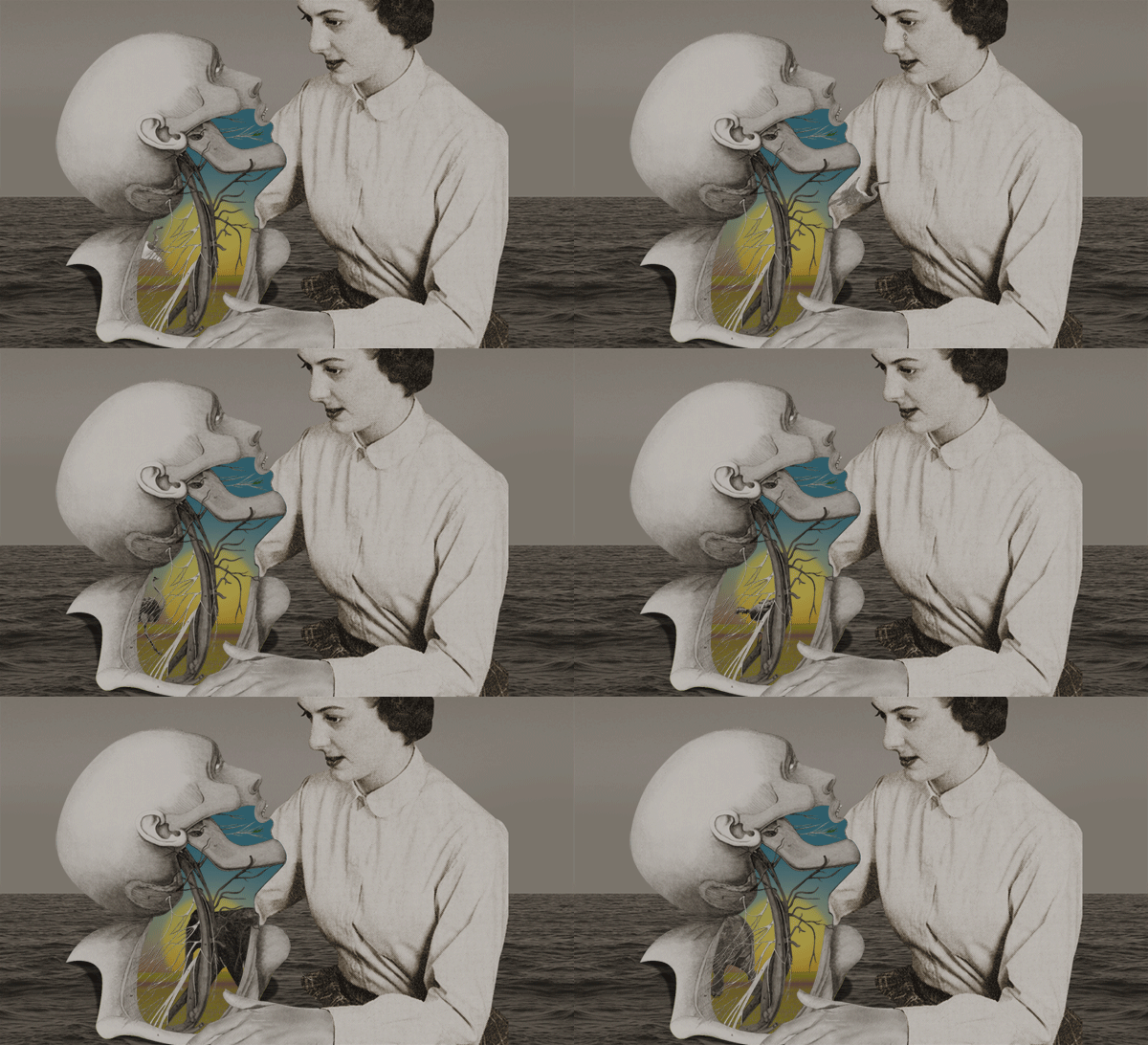
While waiting for his father, John stood in front of the aviary in the empty rec room, trying to remember the name of the small birds flitting behind the plexiglass. They were a pretty green-blue with a small patch of pink between the eyes. Two months before, when John’s father was admitted to the skilled-nursing ward, one of the residents of the assisted-living facility had identified them. “Hell of a thing to be caged,” he added. Though John enjoyed watching the birds dart about, he nodded in agreement. “Yeah, like you know about it,” the stooped geezer said and shambled back to the blaring widescreen tv.
John visited his father every two weeks since his confinement, but hadn’t been in the rec room since that first time. Surprising that two months had gone by. How much longer could he hold up, caged in a bed with an acute mind and a failing body? John could do little for him other than his periodic visits. And he didn’t look forward to those. They were awkward, with unsaid things underneath his approaching death. John was determined to make one of the visits different, and had stopped in the rec room to try to formulate what he wanted to say. Though the tv was off and allowed quiet concentration, he hadn’t formulated a thing, but would keep an eye out for an opening. An opening for what?
“Your father is done with P.T. now, and back in his room.”
John turned to the door to acknowledge the orderly but she was gone. Why even bother with physical therapy at that point? He looked blankly around the room and stepped into the hall to get the visit over with. Peach-faced lovebirds. Like those in Hitchcock’s The Birds. The oddly vacant corridor to his father’s room at the far end conjured another movie, Shock Corridor. One thing missing from that movie was the smell, though an imaginative viewer could summon the pungency.
As John passed the ward station, he greeted the unresponsive nurse who continued looking at a flat-panel screen. The nurse never looked up, not even after John brought chocolate assortments for him and the rest of the evening staff on previous visits. John rubbed his eyelid with a middle finger as he walked by.
The door to his father’s dark room was ajar. Across the hall, the door to the room in which a tv usually blared was shut; the silence brought focus to John’s visit and he wished it were open as it usually was to provide a distraction, even an obnoxious one. He knocked on his father’s door, then pushed it open after there was no response.
Recessed lighting in the corridor ceiling illuminated his father’s tousled white hair and baleful eyes staring at him; he turned his face toward the closed Venetian blinds on his right.
John could have won a bet that his father would react so. It was a predictable gesture that predated his hospitalization for as long as John could remember. He squelched the impulse to turn around and leave. Usually, he could empathize with his father’s plight and ignore the snub, but he’d encountered it on each of his evening visits that week. He’d had enough. He wished otherwise because he would drive back to Raleigh the next day and didn’t want to end the trip on a sour note. He wanted something different in this visit, in their relationship, but maybe this wasn’t the right time. He flipped the overhead fluorescent light on and said with mock cheer, “Nice to see you, too, Dad.” He shut the door and walked to the foot of the bed.
His father looked down his nose at him with dark gray irises, avoiding eye contact. “At least you’re consistently late.”
“The orderly told me you were done with therapy only a moment ago. I was waiting in the rec room.”
“Ah, the rec room. Of course. Why wait for me in my luxuriously appointed cell when you can wait in the rec room. Did you get wrapped up in a tv program? A game of checkers with one of the other inmates?”
“I was observing the birds in the aviary.”
“Ooohhh, observing. Well, tweet-tweet-tweet!”
“That’s right. Peach-faced lovebirds.”
“Your mother and siblings don’t have trouble getting here on time.”
“What does it matter? You complain if we’re a few minutes late, or a few minutes early and you’re not ready for us.”
His father looked at the ceiling.
It was almost comical, a decrepit old man acting like a petulant toddler.
The Wall Street Journal lay disarrayed at the foot of the bed. John glanced at the headlines for something to talk about but saw none. He straightened the sections and put his father’s eyeglasses on top and went to the cushioned chair at the head of the bed. “How was physical therapy?”
His father’s face turned to the door.
“Okay, if you’re not going to look at me, we can look at the tv. But if you want to talk, I’d like to.”
“What is that? Where’s it coming from?” His father looked around with a mock puzzled expression as if trying to pinpoint the source of an aggravating sound.
John snatched the remote off the adjustable bedside table. “Maybe there’s a ball game.”
“I’ve seen enough baseball. Enough news, enough documentaries.”
“A movie?”
“It’s all the same. Nothing and no one ever changes.”
“Well, I’d like to watch a game.” Or anything to get off the refrain of complaint. John began paging through the onscreen program guide. Before his father’s downturn, they at least enjoyed conversing on the telephone; besides movies, they talked about current events, politics, books. Though in retrospect, it had all seemed like surface conversations, one you might have with an amiable stranger sitting next to you in an airplane for an hour or two. But that enjoyment dissipated soon after he was placed in the ward. Now, tv was a way to pass the time, to sit together but not have to struggle to talk. And his father frequently dozed off, head tilted to the side, one eye half-open and mouth agape revealing old teeth. His death face. John would take advantage of the nap to attend to his cellphone and laptop, when he brought them, grateful to spend time debugging a tangled coding algorithm that would eventually reveal a solution. Readjusting his head and torso on the tilted bed might dispel the disturbing corpse-like appearance, but John didn’t want to take the chance of wakening him. Though he was loathe to admit it, the sight of his once vibrant father confined helplessly to a bed put him off. Once, he had the unnerving thought of putting him out of his misery by clamping one of the pillows over his face and smothering him. How long would it take and would the frail alabaster legs kick? John had shook his head at the image and averted his eyes to the calming code on his laptop screen.
“You’ve got to get me out of here,” his father said as John scanned the channels.
“We’d like nothing better than your discharge.”
When his father was admitted for shortness of breath and swollen ankles and shins, a doctor diagnosed his condition as congestive heart failure. A thoracentesis removed 20 ounces of pleural fluid from around his lungs. His father thought that after the procedure and medication to reduce the swelling that he would be fit to go home. But his legs wouldn’t support him, not even to go to the toilet. His doctor advised him early on to begin thinking of his stay in the skilled nursing ward as long-term.
John turned to see his father glaring at him. At least there was eye contact.
“Don’t pretend that you don’t know what the prognosis is.” His voice caught in his throat. “You all conspired to warehouse me in this dump.”
“Come on, Dad, we couldn’t give you the care that you get here.”
“Care? We suckers in here are nothing but a herd of cash cows. They care for us as long as they can milk us.”
“Your lawyer said this is the premier facility in the area.”
“Bullshit.”
John turned to the tv; there was nothing he could say that his father wouldn’t counter.
“That’s it, ignore me.”
“Oh, it’s okay for you to clam up but not me?” John smirked at his father’s lack of self-awareness and muttered why he bothered to visit, shook his head at his earlier desire to make one visit different.
“What’s that?”
“I said why can’t I remember what the MLB station is.”
“Maybe if you visited me more often, you’d remember.”
“I come as often as I can.”
“Move back here. There are plenty of software jobs in this area.”
“I can say the same, about moving. I tried to get you and Mom to move to Raleigh years ago but you dug your heels in.” He scrolled through the guide. “We’re as settled there as you are here.” His wife was involved in several civic activities and had established friendships; his elementary school-age daughter and son were happy at their school and likewise had friendships. His family had no interest in moving, especially with the mountains or the beach an easy drive away. “We’ve got a life there.”
“I’m so glad that at least one of us has a life. I hope I’m not taking too much time away from yours.”
“It’s not a problem.”
“It’s not a problem,” his father mocked. “You really think your little visits help me? You come and sit there like a ventriloquist’s dummy.”
John shook his head and continued searching for a ball game. He wanted to conclude the insult-phase of the visit and move to the wordless-phase that ball games facilitated.
“Hey, Knucklehead Smiff, your little obligatory visits don’t do a thing.”
“In that case, there’s no point in me being here,” John snapped. And to hell with the heart-to-heart. Why waste time? “I’ll find you a ball game, or not, and leave you to it.”
That shut him up. But one more wrong word and the visit would abend. No, it wouldn’t be an abnormal end, but a normal one. An abend would occur if things got better between them. Distracted, John accidentally pressed OK on the remote and a reality tv series, Sand Through the Hourglass, filled the screen. The scene was coincidentally set in a hospital room, with several squabbling characters hamming to the camera. It was the exposition part. The episode seemed to mirror the conversation that he and his father were having. More unsettling, he and his father seemed to mirror the episode; their visit was devolving into a hackneyed tv segment, though perhaps their relationship had always been hackneyed. Did John’s visits resemble trite tv programming because he and his father couldn’t, or wouldn’t, venture any deeper into their relationship? Could be. After all, his father noted a moment before that no one ever changes. And what would they find if they dug deeper? A cranky old man facing slow death; a tolerant, ineffectual son who couldn’t do anything for him other than to keep company. A couple of two-dimensional characters straight out of central casting, without the melodramatic affectation. John had the eerie feeling that they were being drawn into a reality-show facsimile of their contentious relationship. He glanced around the room to ensure that there were no cameras.
“Hey, look, we’re on tv,” his father said.
Though it might be so, John denied it. “I don’t know what you see, but that’s not us. It’s not me, anyway.”
“Leave it on.”
His father’s request surprised John; his entertainment preferences were usually more discriminating. “I’m not watching that tripe,” John said. He muted the sound, maximized the guide, and continued looking for a game, chagrined that perhaps they were just two players in a reality-tv show. He wanted a reconciliation, but not a contrived one. “One of our favorites starts at eight,” John said idly. “The Godfather.”
“I could quote that line for line in my sleep. Go back to that show.”
“Ah, here it is, MLB Tonight. The Reds and the Pirates at Pittsburgh. Starts in fifteen minutes.”
“I can’t even watch what I want.” His father struggled to sit up but wouldn’t deign to ask for help.
“Can I do anything for you?”
“The toilet. What else would I be doing? Huh, Knucklehead?”
It was the one-more wrong word, but it was just a word. Besides, John didn’t want to clean up an accident. “Alright, let’s get you secure.” He sighed. There would be no difference in this visit. He helped his father to the edge of the bed and strapped the balance belt around his emaciated mid-section. On the count of three, John hoisted his father’s hunched body up and supported him as he shuffled to the bathroom like a walking question mark, his pajama cuffs dragging on the linoleum. John got him seated, then stepped out to give him privacy and to avoid seeing him squat. He looked at the tv for a distraction. Sands Through the Hourglass was still minimized in the upper right corner of the screen, and gave him the creeps. He switched channels to the baseball pre-game show.
A moment later, the toilet flushed. Glad that he didn’t need to wipe him this time, John knocked, then held his breath and turned on the fan. He helped his father to the sink and noted his filial resemblance to the white-haired man in the mirror as he held his soapy hands under the warm water. John was even a bit haggard. Just hang in there for another hour or so. An hour? Imagine two months of it.
His father shakily turned off the faucets and noticed their juxtaposed images. He struggled upright so that his lightly stubbled gray face obscured John’s. He was still a tall man. “This is what’s in store for you,” he said.
John cringed to think of eternal bed-ridden days. There was no way that he was going through the same. He held the balance belt with one hand and pulled a paper towel out of the shiny dispenser with the other and held it out.
“This is it, isn’t it?” his father asked as he weakly dried his hands. His eyes brimmed in the mirror. He drooped his head and resumed the persistent aching slouch, pulling the balance belt with dead weight.
The whirring fan seemed to increase its speed and decibels.
The old man lifted his head to the mirror. “Nothing to say?” he asked earnestly.
“Yes,” John said, surprised that his father was asking his opinion. It was the opening that he’d been looking for. “But let’s get you back to bed first.”
“Let’s hear it now.” His father didn’t look away as he always did when contradicted or challenged. His direct gaze was one different aspect in the visit.
“It’s just that—I want something different in our relationship, Dad. Not this surface aggravation every time we’re together. We can go deeper.”
His father snickered. “Listen to the poet.”
“Forget it.” John yanked on the belt. “Now, come on.” He could have lugged the old man like a heavy suitcase. When his father weakly grasped the rim of the sink bowl to resist, John tightened his hold.
“I don’t have any time left for such a commitment,” his father said. “Who says it’s surface, anyway? We’re already deep enough.” He scoffed. “And you really think we could start over in a few minutes?”
“We could at least make a start. But forget it, I said.”
His father loosened his hold on the sink. “Okay. You want something different?” he asked contritely. “Well, then, let’s take stock of where we are.”
“Yes,” John said. “Good.” He looked at the sparse white whiskers in the mirror. “Say, how would you like a shave first? Start fresh.” He rubbed the back of his fingers playfully on the stubble. “Your electric handy?”
His father smiled weakly and his eyes narrowed; if he were younger, the expression might have been sly. “No shave. And no bed, either. Take me to that aviary that so fascinated you. Share that with me.”
“Uh, sure,” John said. He hadn’t exactly been fascinated by it, but taking him there was something to do. They could talk. “Hang on, and I’ll get your wheelchair.”
“My robe, too.”
John was encouraged when his father asked to go to the aviary, but surprised by the request. He pushed the wheelchair toward the bathroom where his father’s shadow fell across the threshold into the room; he couldn’t remember his father ever asking him to take him anywhere. John locked the brakes and helped his father into his robe, then eased him onto the seat and covered his legs with a red plaid throw blanket against the chill air-conditioning.
In the corridor, John pulled the door shut, and they proceeded to the rec room over carpeting that was arrayed with dizzying gray and purple horizontal lines. John hadn’t noticed it before. Ahead of them, a cross-corridor intersected the main corridor at the nurses’ station, appearing disjoint at the junction like a refracted pencil in a glass of water.
“We’re off to the aviary,” his father said to the station nurse. “Two birds of a feather.”
The nurse didn’t respond.
“Flock you,” his father muttered.
Another small encouragement that this visit might be different. “You tell him, Dad.”
“I’ll tell you, too.”
As they neared the rec room, yelling voices resonated into the corridor. Sands Through the Hourglass.
“Listen,” his father said enthusiastically. “They’re playing our show.”
John clenched the wheelchair handles and stopped. “I didn’t bring you here to watch that.”
“What’s the matter? Afraid to see yourself?”
“What are you talking about?”
“You know.”
He was obviously very tired, not making sense. “Okay, if this is what you want.” John pushed him into the rec room.
Gathered around the enormous tv screen were a dozen residents, one of whom was drooling in his chair. The episode seemed to have peaked at its scripted clamorous climax and was sliding to a sappy reconciliation.
“Here’s the aviary,” John said peevishly. He positioned the wheelchair in front of it.
His father watched the tv over his shoulder.
“Dad, the aviary.”
He turned his head to the plexiglass. “How impressive. You can even see one or two.”
The birds were still, hardly visible among the plastic foliage. John rapped a knuckle on the plexiglass but they didn’t rouse.
“This is sooo fascinating. I can see why you were late.”
“You’re bringing that up again?” John asked, raising his voice. “We’ve come full-circle. You’re right, nothing ever changes.”
Several residents turned in their seats. “Shush!”
His father pointed at the tears, hugging, and self-reproach that filled the big flickering screen. “Look, son, they stole your idea. They’re going deeper, deeper to a happy ending.” He looked at the aviary. “Like this…” He stagily pressed his hand against the plexiglass, spreading his gnarled fingers as if to commune with the birds. “This gesture is used a lot.”
“Would you not do that?” John asked.
“Don’t tell me what to do, Knucklehead!”
“You’re going back.” John abruptly turned the wheelchair to leave the room.
His father clasped the wheels. “Don’t bother. There are other attendants.”
“But I’m here now.” The old man’s grip on the wheels was surprisingly firm.
“Listen, you, you’re just an observer here.” He chuckled. “And you wanted to get beneath the our reality.”
“I did want to. And you’re acting contrary only because it was my idea.”
“Acting?” He looked to the imposing tv screen.
John figured that he was dismissed, but his father turned back scowling.
“Well, let me tell you something my Kraut-Mick friend, I’m gonna make so much trouble for you, you won’t know what hit you. Now you get the hell outta here!”
“Quiet, please!”
John thought his father was joking with some movie quote, but realized by his steady humorless glare that he wasn’t.
“Nothing to say?” he asked, not earnestly as before. “Again.” He tightened his lips and looked away to the windows and closed French doors that led to a small patio. The black windows reflected the scene inside.
“I’ll see about another attendant,” John said. “It’s always good to know where you stand. Even when it smarts.” He waved goodbye at his father’s wispy image and left. In the corridor, he tried to identify the movie. It was on the tip of his tongue. At the front desk, he asked the receptionist to arrange for an attendant to take his father back to his room. As he reached for his car door handle, a familiar face stared back from the tinted window. He remembered the movie with a compensatory sense of satisfaction. The Godfather, a picture they both admired very much.