

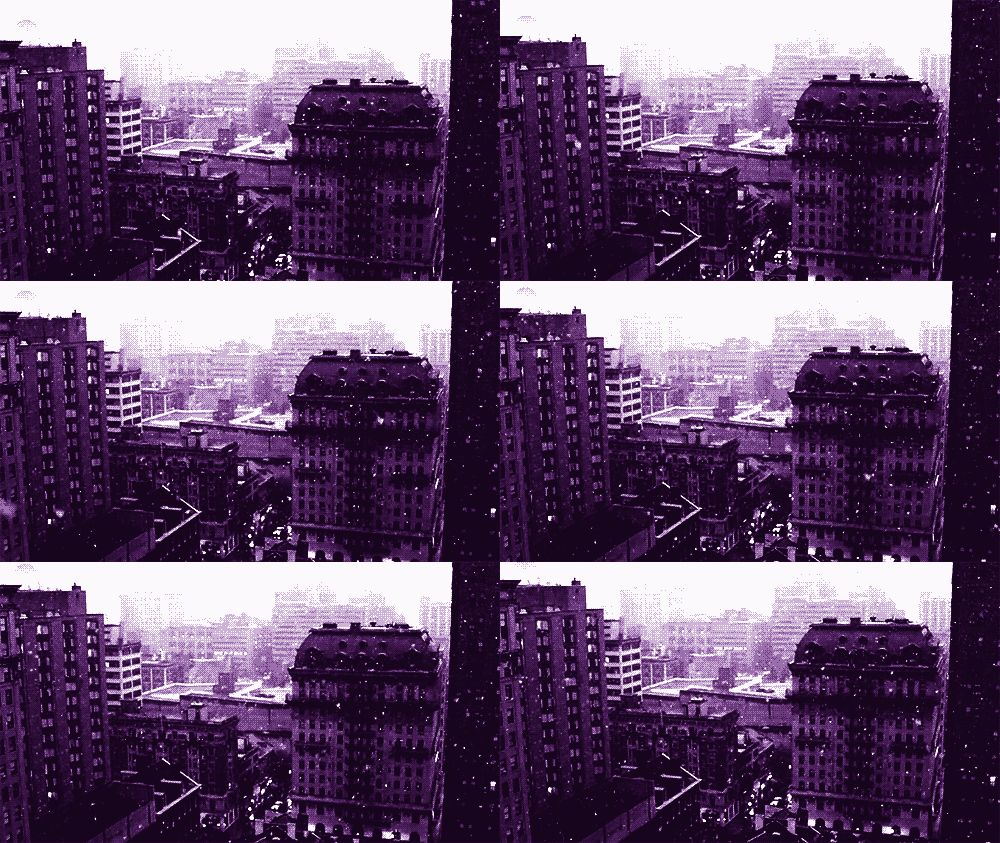
Winter had finally closed in, and Simon’s weather app had predicted the first snow of the season to begin sometime around 5 p.m. Last spring, the doctor had operated on his hip. He hadn’t recovered and was still walking with a cane. His apartment was just five blocks from his shop, but he didn’t want to chance the possibility of slipping in the snow again.
Had he known a storm was moving in, he’d have scheduled Mrs. Huntsworth’s appointment for earlier or perhaps even canceled it. He could do little about that now. The woman, a client who between the business she steered Simon’s way by ecstatic recommendation and the copious amount of jewelry she bought herself, nearly single-handedly kept him afloat.
She had told him she’d arrive at four-thirty sharp, but didn’t arrive until almost six. Her lawyer had kept her overlong, she explained, regaling her with stories from his youth, when he was captain of the diving team and seducing girls in Indonesia. Now, across an hour, she had sampled half of Simon’s latest inventory.
“My ex sold his company last week,” Mrs. Huntsworth said. “Isaac, my lawyer, assures me I’m guaranteed half at minimum.”
“Mrs. Huntsworth. You’re the hardest-working person I have ever met. You deserve everything you get.”
Simon polished the sapphire and emerald bracelet she had just rejected. She was right. The piece on her fleshy wrist had looked cartoonishly dainty. But the woman wouldn’t be dissuaded. The news of her impending windfall had sparked a fever in her, it seemed. She was outright giddy, in fact. Come hell or high water, Simon knew, this woman was going to leave with something, even if only a trinket. Sure enough, she tried on every ring, necklace, and pendant in the shop, three times, no less.
“Ronald wouldn’t even have thought of starting in the semiconductor business if not for me.”
“He’s nothing without you. Everyone says so.”
“But, my dear,” she said, reviewing the inventory further with a sour face, “you know very well that I prefer rubies.” She played with her hair in the mirror. “They’re my birthstone. And anyway, they match my current look.”
At least an inch of gray had sprouted beneath her red hair since he last saw her. No doubt he would be the last to say as much. “If you’d like,” he said, “I can make you a bracelet with rubies. The thing is, unfortunately, I’m sorry to say it will take a few weeks.”
Mrs. Huntsworth removed another bracelet and with lidded eyes set it on the counter. “That truly is a pity, Simon. I can’t bear to leave without something. I’m dining with the mayor in an hour.”
Simon’s app had badly miscalculated the intensity of the storm. All the while he had been tending to Mrs. Huntsworth, he’d watched with anxiety as the heavy snow swirled through the halo of light outside his window. Minute by minute, the stuff was piling ever higher.
“But what about the earrings you tried on? They looked absolutely marvelous!”
“I need something big and bold. Like me.”
Mrs. Huntsworth collected her bag and asked Simon if he didn’t mind her using his facilities. He assured her that he had designed the bathroom more to please his clients than himself. She made her way down the little hall, and Simon started his Chopin playlist. Meantime, he cleaned the jewelry she had tried on, then arranged them in their cases, despite that the moment Mrs. Huntsworth left he’d have to put it all in his safe.
She emerged, at last, her face flushed and sweaty. Simon was astounded to see she had packed her enormous her bag so full of toilet paper she couldn’t zip it up.
“My driver,” she said, and tossed her phone on the counter, “is delayed and won’t arrive for thirty minutes. Something about an accident on Bahnhofstrasse.” She looked at Simon with the eyes of a victim. “It’s very hard these days to find good help.”
She sampled the same pieces again and rejected them with equal dissatisfaction. At last her driver texted to say he’d arrive in a few minutes.
“I do so hate to leave empty-handed,” she said.
Simon looked at Mrs. Huntsworth’s swollen bag. He couldn’t help himself. “Don’t you mean simply that you’ll be parting without a new piece of jewelry?”
“I beg your pardon?” Mrs. Huntsworth’s glare could have wilted all the tulips in The Netherlands, Simon thought. Yet still he went on.
“I mean to say simply that I’m very sorry there was nothing here to meet your tastes better than my toilet paper.”
In an instant, Mrs. Huntsworth transformed from aggrieved victim to indignant malefactor. “Never,” she shouted, “never, not once, have I encountered such a petty little man!” Of course, she did not return the toilet paper. It was hers now, all ten or twelve rolls of it. She swooped up the bag and huffed toward the door. Her liveried driver opened it for her, and she crouched beneath the umbrella with which he’d been waiting.
It was well past 8 p.m. when Simon finally closed the shop. The snow fell around him thick as autumn leaves in a wind. He couldn’t discern where the sidewalk ended and the street began. He’d walked with his cane in the snow just once before, shortly after his surgery last year, to disastrous effect. He had slipped on an icy patch on the street and taken a horrific tumble.
In this case, the streets lay so heavy with snow an Uber wouldn’t arrive for an hour, if it arrived at all. His apartment was close enough to justify the walk. He poked through the dark like a blind man and slowly dragged his feet. That a heavy pall of snow had already rendered his stoop a small Alpine slope nullified the relief of having reached his flat without incident. Of course he misjudged the first step and lurched forward with such unexpected speed that he smashed his nose on the step beneath the snow.
Fortunately the doorman had seen the farce play out and rushed from his desk to help the poor man. Simon had been nothing but kind, not to mention he always tipped the doorman more at the holidays than any of the building’s other occupants. He gave Simon his handkerchief and walked him to his door.
Simon stayed in his apartment for three days and would have remained longer if not for an important appointment. This was his most profitable time of the year, and missing it wasn’t an option. But his client failed to show—no text, no explanation. In fact, none of his appointments showed up, and only one assistant called to apologize. When Simon asked if their employer wanted to reschedule, the assistant politely declined and wished him happy holidays.
Simon hobbled to the restaurant he had dined at every Friday night for the last twenty years. The hostess—the proprietor’s granddaughter—shifted nervously when she saw him.
“Hello, Sofia,” Simon said. “My usual table, please.”
Sofia tapped her notepad and scrolled through the chart. “I’m sorry, Mr. Baumann,” she said, “but I’m afraid we don’t have any available tables.”
Simon could see very well that half the room was empty. “Are you expecting a wedding party soon?” he said.
“I’m sorry,” Sofia said without looking up. “We simply don’t have any space this evening.”
A car took Simon home, where he microwaved a frozen lasagna and watched a football match on TV. In the morning he hobbled to the corner dry cleaner with his three gray suits.
“Nice to see you, Martin,” he said. Martin looked like a hitman had just walked in. He turned to fidget with a crumpled dress. “Time to clean the uniforms,” Simon said. “Looks like I spilled a little tomato sauce on this one. Think you can get it out?”
Martin pushed the suits back toward him. “I’m sorry, sir,” he said, something he’d never called Simon. “We can no longer accommodate you.”
“I don’t understand?” Simon said, truly bewildered.
Martin refused to face Simon. He took up another rumpled item, then paused, his eyes fixed on the counter. “Please just take your suits and go, and we won’t have any trouble.”
Throughout the week, Simon encountered the same treatment everywhere he went. Whether at the café ordering coffee or at the cobbler’s shop to have his shoes resoled, it was as if a spell had been cast. He had been rendered persona non grata. Over the following months nothing changed. If anything, it grew worse.
Not a single one of his regular clientele visited him. His phone no longer buzzed or rang. He made his way to the shop each morning and, save for the occasional tourist, returned home without having spoken a word even to his suppliers.
Then in the middle of the night he sat up with the bulging eyes of a man struck by celestial revelation. Dressing hurriedly, he rushed to his shop, where he worked in a frenzied state for weeks. The result was the most exquisite ruby-laden bracelet he had ever created. When it was finished, he wrapped it in gilded paper adorned with an orchid, took a car to Mrs. Huntsworth’s home, and rang the doorbell. He stood nervously in the entryway.
The maid answered. “Can I help you, sir?”
“I’m here to see Mrs. Huntsworth.”
“Mrs. Huntsworth is resting and isn’t taking visitors.”
“Please, I’ve brought her a gift.” Simon held up the gold-wrapped box, his hands trembling.
The maid took the gift from him. “I’ll make sure she receives it. Now, if you’ll excuse me, I need to get back to work.” Before Simon could say another word, she shut the door in his face.
Several months passed during which Simon’s business continued to wither. He terminated his lease and emptied the shop, by himself, bonded to the cane he’d grown increasingly to despise. He swept the floor in tears, knowing this was the last he’d see of his beloved shop. And then, just as he kneeled to fill his final dustpan’s worth of debris, in walked Mrs. Huntsworth.
“What is happening here, my dear friend?” she said. She might have been talking to a relative on their deathbed.
“Mrs. Huntsworth,” he said, baffled.
The woman set her bag on the counter. It was full of the same toilet paper she’d absconded with all those months before. The ruby bracelet Simon had made for her glittered on her wrist.
He could not make sense of any of this. It was something from a terrible film.
“I’ve come to peruse your latest designs.”
“As you can see, I have nothing to show you.”
“My dear,” she said. “Please. Have mercy on this repentant woman.”
In his grief, Simon had overlooked a box in the corner. He picked it up, scarcely able to make it to his empty case. He placed the jewelry piece by piece on the counter, and before he’d emptied the box, Mrs. Huntsworth held up a gold necklace with a red opal pendant.
“How much is this?” she asked.
“Thirty-five,” he said.
Mrs. Huntsworth pouted. “Would you take twenty-eight? Embarrassed as I am to admit it, things have been a little tight.”
Simon took the necklace, and put it in the box. “I’m afraid not,” he said, and turned away.
Mrs. Huntsworth’s mouth opened, yet she said nothing. She stood a moment, flabbergasted as Simon cleared the counter. His whole body felt that it had been charged with lightening. Mrs. Huntsworth could say nothing, he knew. She left the toilet paper on the counter and walked out the door.
It was a lovely spring day. The hyacinths and crocus were in bloom. Simon watched with satisfaction as Mrs. Huntsworth slid into the seat while her driver held the door. Locking his shop for the last time, he picked up his box of jewels and strolled leisurely along the river.
Home at last, he popped a frozen Rösti in the microwave and switched on his TV. FC Zürich was two goals up on Lausanne. When the microwave dinged, he sat on the sofa savoring every bite. It was the best thing he’d ever tasted.