

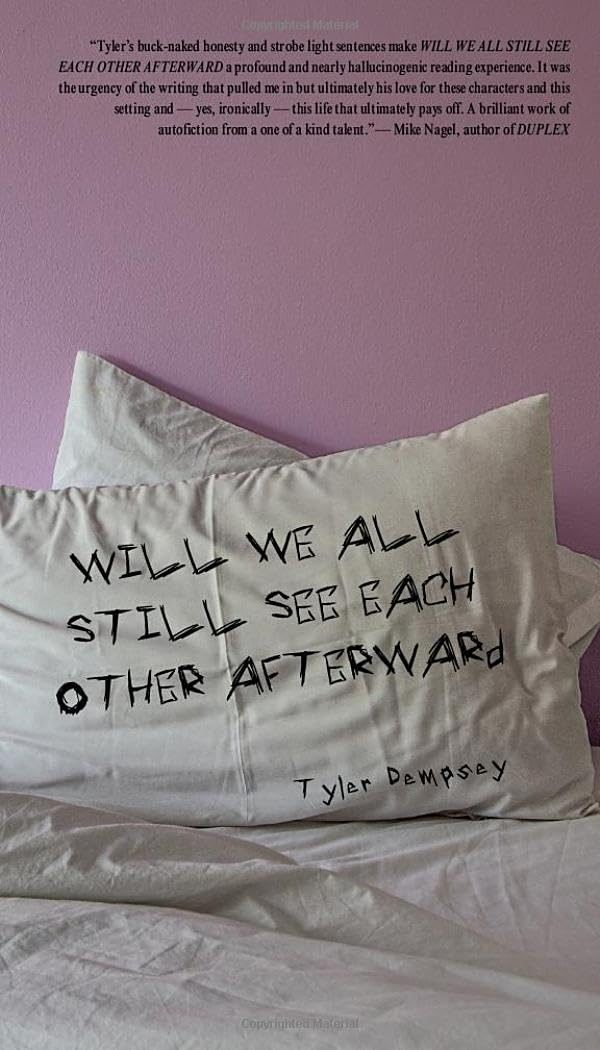
Charles Bukowski called love a dog from hell but Tyler Dempsey shows it to be an animal resilient enough to withstand arctic freezes and the weeks-long days and nights of life near the top of world.
A love triangle with barely-erased phantom vectors and points, the book tracks the messy fallout after the end of a relationship between Tyler, a park ranger at Denali National Park in Alaska, and the mysterious L—.
Told in sentence or two fragmentary paragraphs, text messages, emoji, descriptions of GIFs, and the occasional QR link to hiphop-heavy playlists, it’s a novel that cuts out most of the fat that is the meat of so much fiction yet somehow manages to retain the gravity and resonance that separates art from the commonplace blog entry or social media gripe.
I thought of Sam Pink’s work while reading the book but mostly because of the way the spare sentences look on the page. Dempsey’s point of view is more intimate, softer than Pink’s. To be sure, both writers have no shortage of male bravado, but Dempsey’s approach is gentler. Or, at least, that’s what he projects. I mention Pink because he’s a master of this deceptively simple style of prose and there are many imitators who do nothing but copy it without adding anything of their own. Dempsey definitely has his own thing going. His setting, for one, is as much a character as the stand-ins for himself and his paramours are.
The day-to-day difficulties and absurdity of life in Alaska serve as a fitting backdrop for the soap opera of Tyler’s love life.
A woman in a blue fleece that says ALASKA, hood drawstringed so only her nose and bottom halves of her eyes show, tries for our attention. On tiptoes with her arm all the way up, waving a pink, frilly glove. Like we’re soldiers leaving harbor and she hopes the image burns in our minds before we die.
Tyler, L—, Kristie B. (the woman Tyler hooks up with to get over L—), and several others all work in and around Alaska’s tourism industry. The remote harshness of the environment leads to moments of casual intimacy that might seem uncomfortable in a more temperate setting. For example, the first time Tyler visits Kristie’s house he jumps in the shower first thing, right after saying hello and dropping the pizza he brought over on the counter. It’s a particularity of their lives that it’s assumed after the miles he has to travel just to come over to watch Netflix that he be allowed to clean up to make himself presentable. Many small details like this separate Dempsey’s novel from so many other chronicles of messy millennial love. But there’s no shortage of mess and ugliness.
On the rebound after his breakup, Tyler speculates about why Kristie wants to hang out with him.
Katie and Abby split up a few months back
after four-and-a-half-years. I’m assuming
L— told Katie about our breakup and now
she’s looking for solidarity. Mostly to
heckle/interrogate me.
We’ve never kicked it without company.
Hence the assumption.
I’m sad/lonely enough to take that
punishment.
What follows is a lot more than a casual hookup and the fallout leaves more carnage than the relationship that precipitated it. I suppose the lazy shorthand for this kind of writing is auto-fiction but I’ve never found that to be a term that does anything but demean or diminish, or, worse, serve as branding. Writers since cuneiform days have used their lives as material for telling stories. Where else would it come from? The fact that Dempsey uses his own name for his protagonist will spur the obvious question of how close this narrative hues to his life but even if he were to answer it would not account for what makes this book ring true.
A more interesting question is why L— is the only one whose name is hidden. It makes her the most important person in the story though she’s barely ever on the page.