

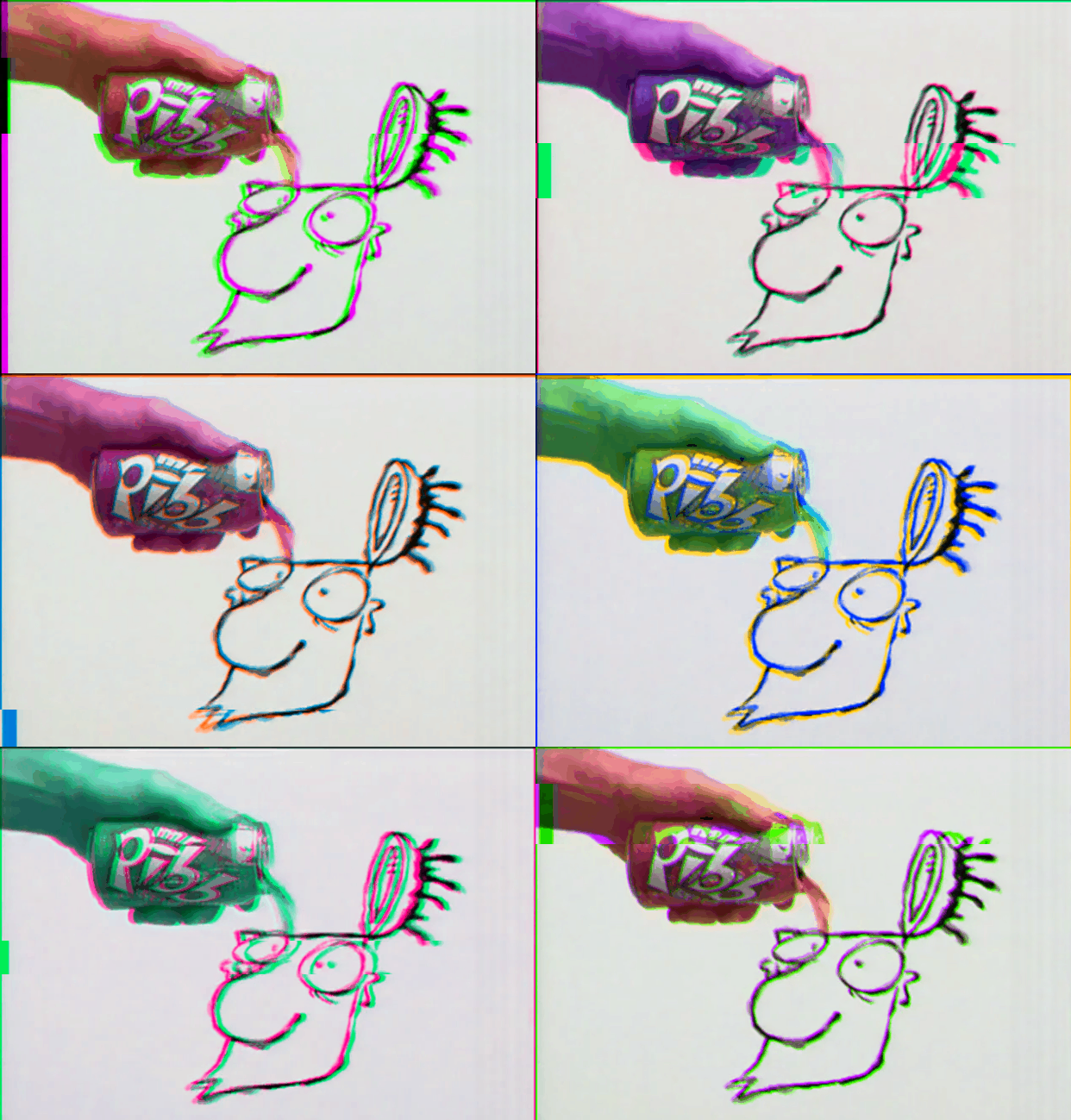
1. Forget Your Name
Usually they get professionals or singers or celebrities to do this kind of thing, but today they’ve chosen you. You become this sort of Jake from State Farm for Mr. Pibb. As part of the contract you have signed, you must legally change your name, and from here on out only be referred to by friends, family, and the general public as the following: Mr. Pibb, Pibb, Pibbster, Pibbist, Sir Pipp, and several other variations of Mr. Pibb. They do, however, make it clear that under no circumstance are you to call yourself Dr. Pibb despite any doctorate in literature you may have received. The similarities between Dr. Pibb and Dr. Pepper would be far too susceptible to a lawsuit from the Pepsi Company.
Your wife is unreasonably supportive of your decision to change your name to Mr. Pibb. You can’t tell if it’s due to the fact of the modest stipend that the Coca-Cola company has provided or if she genuinely is fond of the name Mr. Pibb. When you make love, she tells you that it is the best sex she’s ever had, and you suspect part of the reason is because she was screaming, “Pibby! Oh, Pibby! Fuck me, Mr. Pibb! Come inside of me Mr. Pibb!” While she is saying all of this, for a brief second you forget your name.
2. Don’t Mind the Animated Babies
Before the filming of advertisements, you must follow a strict diet, which does not include any Mr. Pibb and instead requires the constant consumption of rice, chicken, water, and performance-enhancing drugs. You must hit the gym twice a day and run at least five kilometers. You spend some time looking at your naked body in the mirror. You look good. You look like the sculpture of a Greek god. One day they will build a statue of Mr. Pibb, you think to yourself. Once in this perfected ideal form, you start shooting commercials, many of which include the claim that you achieved such a physique through a diet of Mr. Pibb. It is during these commercials that you first try Mr. Pibb. It isn’t the Mr. Pibb sold to consumers but a highly diluted version. The regular Mr. Pibb has far too much sugar. The diluted version tastes like carbonated dirt.
Commercial shooting will take a week, but the individual commercials will be broadcast worldwide for the next six months. Many of the commercials introduce other characters in the “Mr. Pibb-universe,” including Mrs. Pibb, your loyal and equally fit blond-haired wife; Little Pib, your bug-eyed baseball-obsessed son; Pibby, a golden retriever; and Baby Pibb, your healthy white newborn. During the filming of these commercials, you never actually meet any of the other actors. Mrs. Pibb is shooting from Finland, Little Pib from Canada, and the golden retriever is rotoscoped by an animation studio located in Japan. You will all be artificially imposed in one shot in post. The only actor you directly interact with is Baby Pibb.
Most of the scenes you shoot are quick, done within one or two takes. You are reminded of the passion you once had for theater and how you starred in your college’s production of Death of a Salesman. You try your very best to put all the passion you can into these commercials, but one scene gives you particular trouble. In the scene you are trying to feed Baby Pibb a bottle of milk. The baby is supposed to reject the milk and drink a bottle of Mr. Pibb. However, no matter what you do, you can’t get the baby to drink Mr. Pibb; moreover, the baby feels uncomfortable in your hands. It doesn’t look natural. You look like you have never held a baby before. The director has had enough and decides that they will outsource the baby’s presence to the Japanese animation company. They give you a green brick instead, and you pretend to feed it Mr. Pibb. This causes you to lose the light in your eye, and you worry that you are a bad father to your own son.
3. Go on Late Night Talk Shows
The commercials are widely loved, not only for their humor but also for their cinematography, narrative arcs, and your acting. This is very surprising to you. You don’t remember the commercials or the dialogue being very interesting, but they have propelled you to international fame. The commercials are seen as legitimate pieces of art. You are nominated for several major advertising awards, including the prestigious Cannes Lions Best Acting in an Advertisement, which you win. You are offered several other acting roles in popular movie franchises, all of which you must decline based on your contractual agreement. You are, however, booked to appear on various late-night talk shows across the world on a year-long tour. During these talk shows, you more or less tell the same story: How you used your status as Mr. Pibb to get out of a speeding ticket.
On your final appearance during the tour, the interview seems to drag, and the questions are getting more and more personal. They start asking you if you believe in an afterlife and about your son, whom you are avoiding. You try to stay on topic and bring up Mr. Pibb as much as you can. Then they bring out the second guest of the night, and it is your son Agnus who comes out. You were not made aware of your son being the second guest. He says he’s upset because you named him Agnus, and you say you would never name anyone Agnus. You apologize profusely to Agnus, much to the chagrin of the live audience, who thinks this parental dispute is some sort of performance. You offer Agnus a lifetime supply of Mr. Pibb, which he refuses. He tells you that you’re a shitty Dad, that you chose a terrible name, and that Mr. Pibb is actually far worse than Dr. Pepper. You tell him this all reminds you of “A Boy Named Sue,” the Johnny Cash song about a man who names his son Sue to toughen him up. You point out this song is actually written by Shel Silverstein. He tells you that he doesn’t know who Shel Silverstein is and that whoever he is, he is probably a worse father than you since he named a boy Sue. You try explaining that Sue is actually a fine name for a boy and that Shel Silverstein is a writer, and the boy with the name Sue is from a fictional story, but Agnus doesn’t seem to grasp this concept and gets frustrated. He tells you that you are a bad father because you never told him about Shel Silverstein.
4. Walk on the Moon with the First American Horse
To negate some of the controversy surrounding your absence as a father, the Coca-Cola Company has sent you to the moon. Along with you is an American horse, named Kettle, who is there representing Kettle Cooked Lays Potato chips. The rocketship is automated, and you have to do very little besides feed the horse who resides in a hyperbaric oxygen chamber and can move very little. You enjoy your time on the shuttle, spending your days reading Proust and Beckett and looking out the window wondering if any of this is real. You open your eyes a thousand times to try and remind yourself that you worked for this, that you deserve it, that you are better than them. You are better than those half-ass-ers collecting food stamps and drinking Mr. Pibb.
You are the thirteenth human to walk on the moon and the first to do so while accompanying an American horse. You talk to Kettle every day. You know that it isn’t healthy to talk to horses or any animal for that matter, but you tell yourself it is better to talk to an animal than to no one. You tell him of your early love for theater and literature, how you think Faulkner isn’t as good as people think he is, and how you never actually drink Mr. Pibb, just carbonated water with brown dye. You grow closer to the horse every day. You decide Kettle the horse is the best friend you have ever had.
5. Retire
When you arrive home, they throw a parade in your honor, and as stipulated in your contract, you give the credit to your repeated consumption of Mr. Pibb throughout the flight. You are supposed to be, but you’re not. Your relationship with your wife has grown dull with the long fatigue of life. The two of you rarely talk unless absolutely necessary. You envy the days you spent on the ship with Kettle.
You don’t know where the years go. You are now in your early 50s. The modest stipend of $45,000, and poor investments have left you and your wife broke due to the rising inflation in America. You can sense your wife is considering a divorce, and you are more apathetic to that idea than you thought you would be. You never see Agnus after the talk show, but one day you see him on television promoting a book he has written titled “I Hate My Father and Why That’s Okay.” The book is longlisted for the National Book Award. Thanks to this book, your trip to space has done very little to change your public image. The Coca-Cola company has advised you to take a permanent leave of absence from your world tour.
Since you have been back from the moon, you are constantly dizzy, and the only time you aren’t dizzy is when you are lying completely still, which often confines the entire day to your bed. You don’t film commercials anymore and spend your days rewatching episodes of Two and a Half Men while ordering Chipotle off of DoorDash. Your wife officially files for divorce due to your bedriddenness. Your cash dries up even more thanks to a brutal divorce, and due to the contract you signed, you are ineligible for any Social Security despite your age.
It is revealed to you in an Instagram post that Kettle, the horse you went to space with, died just days after your arrival on Earth. You cry for the first time in a long time. Horse doctors around the world concur that this was an inevitability of sending any horse to space and that the stunt was ill-advised. With your last dollars, you purchase a Greyhound ticket to see Kettle’s family.
6. Montana
It is very easy to find the location of Kettle’s owners on Google, one Myriam and Patrick Coulson. The couple resides on a ranch in Browning, Montana, home to the Blackfeet Indian Reservation and a small population of 1018 people. The Greyhound bus is entirely empty except for you. On the long drive you gaze fondly at how the dry rock and cactus seem to blur together through your vision. You are dropped off by a large concrete teepee, which appears to be a now defunct gas station. The word “espresso” is plastered onto the teepee in bold red letters.
Myriam lives in a small house off of Yellow Wolf Road. She quickly recognizes you and invites you inside. You sit with your legs crossed, feeling the warm cup of tea Myriam has made for you. She reveals that her husband, Patrick, died the previous year due to COVID, and you offer your condolences. She tells you how the two of them inherited Kettle, whose name was actually Bruno, and a few other horses from Patrick’s father, and how they had very little to make do with these last few years.
“We used to own a farm too, a little ways off. We just couldn’t compete with the big companies, and when Lays came around looking for a healthy horse, well, we needed the money, and to be frank, we thought it would be pretty neat if Bruno would be the first horse to walk in space.”
“First American Horse.” You add.
“Oh. I didn’t know that there were horses from other countries that went to space.”
“No no,” you say. “No other horses have been to space, but the administration pushed Lays heavily to include that. It’s just important you say First American Horse.”
“But why?”
“It was in his contract.”
“Oh, okay. I didn’t know.”
“I’m sorry. You know, I actually loved Kettle. I mean Bruno. He was the greatest horse I’ve ever met, and he was my best friend.”
Myriam looked surprised and then as if she were about to say something, but she just smiled and sipped from her glass of tea. You ask if you could help Myriam with the ranch. You aren’t sure why you ask. You have never wanted to work on a ranch before. You can tell this also surprises her, and you’re not sure if it’s because you’re 56 now or because the only experience you have with horses was on a space shuttle. She pauses for a moment, takes another sip of her tea, sets it down onto the table, and agrees if you can do it for free.
Most of the other ranch hands are college-age. They are quite shy, but you don’t particularly mind. All you need is the quiet sounds of Montana. One of the youngest ranch hands, a woman named Jude, seems to take a liking to you. She talks to you about her girlfriend. She does interviews of you for her Tiktok and she has received a modest following for it. She likes to call you Smoky because of your addiction to cigarettes, which you acquired after your wife left you. You realize for the first time in a long time nobody has called you Mr. Pibb. Either the people in Browning don’t care or they don’t know. All you know is that it feels good to be called Smoky. The other workers seem to respect the amount of effort you put into your job. You feel very welcomed. You are invited by Jude to attend the Blackfeet Indian reservation powwow. You have never been to a powwow, and you don’t know what it is, but you still happily agree.
You go to bars where you watch the Montana State Bobcats and meet people older than you. It’s nice to have friends in their 70s and 80s. It makes you feel young again. You see some of these friends at the powwow. You walk through a sea of lawn chairs, weaving through dancing children and curving around a drum circle and finally to the bleachers. As you sit down, a teenager points to you and says, “Mr. Pibb?” and you look away. Your face is flushed and sweaty. “No dude, that’s definitely him,” you hear the teenager say to his friend. You see Jude sitting with Myriam and stand up and pace towards them. “Hey,” the voice gets louder. “Hey, stop for a second. We know who you are.” You start to feel the water in your eyes. As the tears roll down your cheeks, there is a hand on your shoulder. You turn to face whoever has stopped you, and it’s a teenager with the biggest grin you have ever seen. He starts to chant, “Mr. Pibb! Mr. Pibb! Mr. Pibb! ” The chanting gets louder and louder. All eyes are on you. Soon the entirety of the Blackfeet Indian Reservation powwow is chanting your dead name. Myriam is chanting it, and Jude is too. They stare directly into your soul. You stare into the big sky. With tears rolling down, you give the crowd a gentle smile.