

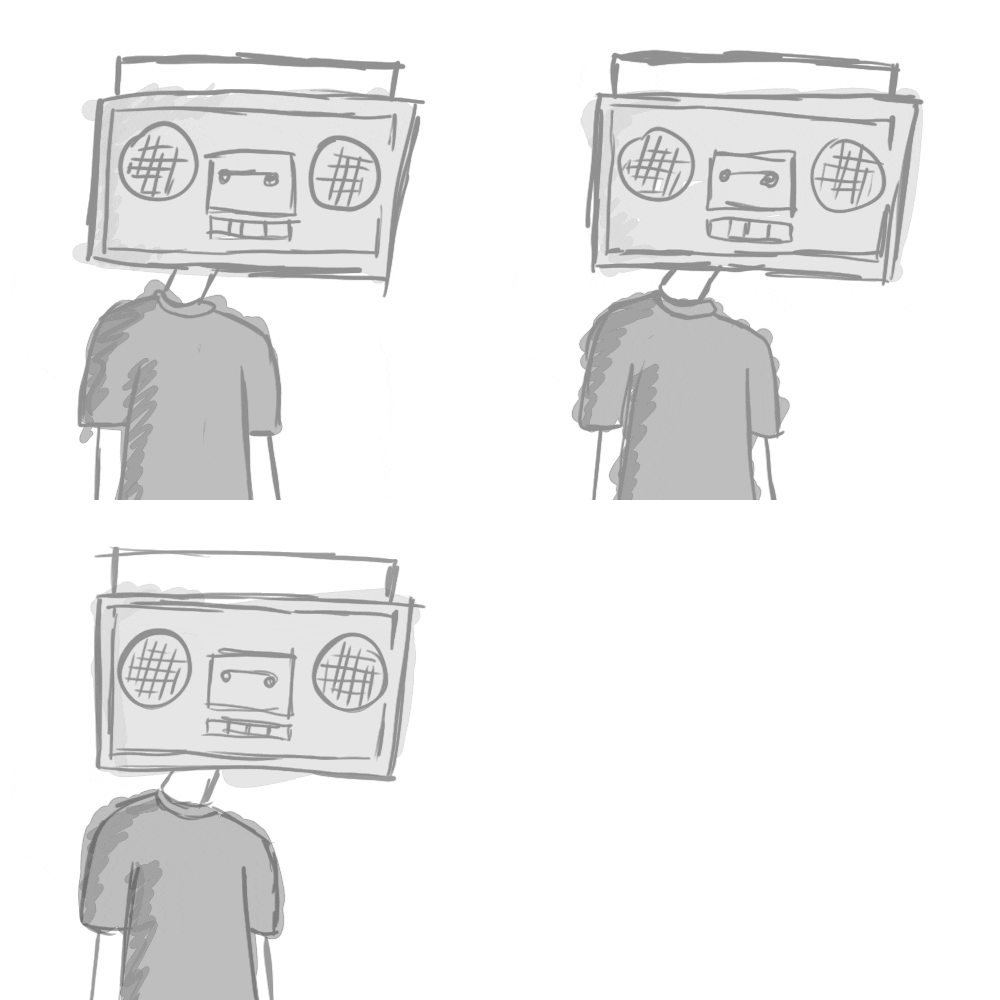
The History of the Decline and Fall of the Bro Empire
By Dr. Carneiro, Keeper of the Pods
Introduction to the 3rd Edition
Recovered from the Ruins of the Spotify Vaults
Published by The Institute of Post-Bro Studies, Reykjavík, Iceland
“The dream of the Bro was not to conquer the world, but to optimize it.
His failure was not moral. It was algorithmic.”
—Fragment From the Diaries of the Sacred Last Jamie.
Introduction: In The Beginning Was The Elk
No one knows when the first iteration of the modern bro appeared. He has worn many guises throughout the annals of history, manifesting as the vagrant, the trickster, the grifter, the Puer Aternus[1], the desert ascetic clutching protein shakes, the Greek orator deadlifting between bouts of sophistry, the medieval monk who takes cold plunges at dawn.
But it was not until the Age of the Pod that the spirit of the modern bro could take stable form. Scholars say the year was 2009[2], when a man in a Tapout shirt asked, “What if chimps had a civil war?” Other learned men argue that the date should be traced back further. Before kettlebells, before alpha waves, back to the smartphone-less dawn, when men sat in circles and misquoted Terence McKenna[3].
But it was in the figure of Joseph Rogan that these scattered utterances found coherence.
He was not a God. Not a prophet. Nor the hero in his recognizable previous forms as king, poet, priest, or man of letters. He was a hero forged in the crucible of modern times.
He was a podcaster.
From a dimly lit studio in Los Angeles, he began to summon the voices of a new pantheon. The tripping mystics. The MMA warriors. The two-hundred and fifty assassins of comedy. Soft-spoken neuroscientists who whispered truths about dopamine like ASMR videos. They came to him not as guests, but as revelations. Each episode became scripture.
He did not preach. He listened. He nodded.
He said, “Whoa.”
He said, “Pull that up[4].”
And the people followed.
They listened while exercising their functional strength[5]. They listened while driving for DoorDash. They listened while not listening to their wives. Their creed: “I’m just asking questions.”
He wore no crown but headphones.
He gave them a new kind of gospel.
Not one of salvation, but optimization.
No sins. Only sleep debt.
No commandments. Only supplements.
And when Spotify built him a golden temple, the Age of Growth began.
This was the height of the Bro Empire.
It would not last.
For in the shadows lurked the opportunistic parasites and actual archaeologists who got tired of hearing about Göbekli Tepe[6]. Comedians who broke out of the stratosphere and grew weary of ritualistically smelling Rogan’s pits. Then came the allegations that not even a late conversion to Christianity[7] could redeem and a famous TikTok star scrolling through Rogan’s image and saying, “Oh, that’s the man from my dad’s podcast.”
This is the story of The History of the Decline and Fall of the Bro Empire.
—
[Editor’s note: Dr. Carneiro’s manuscript ends here. At the beginning. His subsequent disappearance during the Great Unfollowing means we may never know how he intended to conclude this history. The dig at the Spotify Vaults continues.
But scholars at the Reykjavík Institute report strange phenomena. Young men gathering in basements, speaking of “nootropics” and “cold-shock proteins.” They wear different uniforms— canvas pants and minimalist sneakers—but the question remains the same.
“Bruh. But what if…”
The circle turns. The bro never dies. –Ed.]
[1] Puer Aternus — Latin for “Eternal boy.” Originally described in Jungian psychology as the archetype of the man-child who refuses psychological maturation. Later “brocapsulated” by functional movement theorists into “The Infinite Grindset”—a philosophy asserting that peak performance in any field requires maintaining the hormonal optimization of a male teenager.
[2] The Tapout Revolution (2009) — Often cited as the verbal manifestation of the Bro Logos, the moment when scattered masculine anxieties crystallized into a coherent worldview. The phrase “What if chimps had a civil war?” represents what bro theologian Maximus Bodimus calls “the Genesis moment of speculative masculinity.” Archaeological evidence suggests this utterance was immediately followed by a discussion of whether a silverback gorilla could defeat a Navy SEAL. See The Apocryphon of Bear, Fragment 3: “Bro, like bro…just hear me out, bro. What if he had tactical gear?”
[3] Views on Bro Origin — Bro scholars remain divided on a formal inception date. The Icelandic School (led by Professor Björn Ragnarsson at the Institute of Post-Bro Studies) favors the 2009 Podcast Genesis Theory. While the Texan Revisionists trace the movement back to Rogan’s comedy career—specifically, his 1994 bit about eating elk meat. The radical Berkeley Faction argues the true origin lies in his Fear Factor era, where he first demonstrated the ability to remain calm while watching people consume bull testicles. A skill later recognized as fundamental bro training.
[4] “Pull that up” — The central and liturgical utterance commonly interpreted as an invocation of the Sacred Last Jamie. Considered one of the oldest phrases in the Bro Canon predating “Roll the clip” by several cycles. Commonly interpreted as the summoning of the Sacred Jamie, the Eternal Research Assistant, who exists in a quantum state between human and Google algorithm. In orthodox bro theology, each “Jamie” sacrifices his individual identity to become part of the eternal Jamie-consciousness, forever ready to retrieve videos of either ancient civilizations or people getting knocked out. The phrase carries a deep metaphysical undertone: to “pull that up” is to assert that all truths can be YouTubed.
[5] Functional Strength — A sacred discipline of the Bro Empire distinguishing true bros from mere gym-goers. Unlike “aesthetic strength” (dismissed as vanity), functional strength demands the ability to deadlift your bodyweight, execute a spinning back kick that could “definitely end a fight,” and possess the core ability to accurately fire a bow while balancing on a log.
[6] Göbekli Tepe Fatigue Symptom (GTFS) — Also known as Hancock Derangement Syndrome or Flint Dibble Disorder. A psychological condition affecting professional archaeologists who experience acute stress from hearing their life’s work dismissed by a man who believes ancient civilizations had Wi-Fi and could move pyramid blocks with their voices. Symptoms include: involuntary eye twitching, compulsive citation of peer-reviewed sources to anyone who will listen, and the reflexive chanting of “extraordinary claims require extraordinary evidence” as a protective mantra.
[7] Conversion to Christianity (Late Stage) — A desperate strategic maneuver commonly deployed during empire collapse phases, typical right before career-threatening controversies. Historical precedent suggests a 17% success rate within six months of a major scandal. The connection between this work’s title and Gibbon’s The History of the Decline and Fall of the Roman Empire is not lost on this author. Both chronicle the inevitable decay that follows when empires abandon their founding principles and the general failure of late-stage religious conversion as a salvage strategy.