

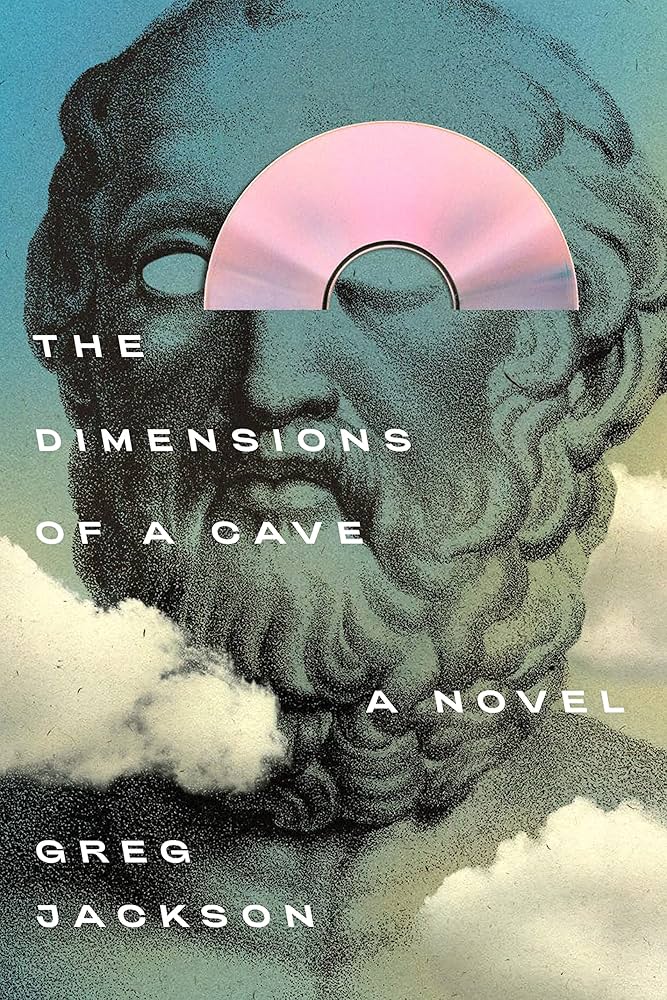
There are books that make one paranoid and there are books that leave one insensate with paranoia. With so much content to compete with, it takes either a fortunate commingling of external factors or a book with real spine to evoke a physical reaction. The Dimensions of a Cave leaves one with a lingering sense of claustrophobia imparted by cubic miles of tightly packed human experience overhead, underground.
You may remember Jackson and his particularly dense sentences and eccentric monological characters from his debut short story collection “Prodigals,” which contained the memorable “Wagner in the Desert,” which was featured in the New Yorker. Since 2016, ostensibly, Jackson has been crafting something with 0% of the whimsy and humor from Prodigals that you might have been looking forward to. This new book is serious literature, wrestling with prescient issues that don’t come with satisfying answers.
The Dimensions of a Cave unfolds in a layered narrative that will evoke Conrad for many—rightly so. We descend headfirst into the mind of Journalist Quentin, as he narrates a story to a few old journalist buddies over a weekend at a beach house. We follow Quentin by headlamp through the claustrophobic tunnels that open up into the catacombs of power, where vaulted philosophical dialogues echo eerily and unclear motivations drip from stalactites.
A few main points of context for the plot: the war on terror and the rise of the information age. Jackson begins with Quentin’s steadfast journalistic and moral integrity:
“what we believed with fervor was that a single, knowable reality existed and that it was every last person’s right to know what this reality was.” (pg. 5)
There lies Quentin’s motivation: the last of his friends to practice the hard life of investigative journalism. Quentin’s dedication to a singular truth serves as a foundation, whereupon Jackson examines the the ethics of epistemic extraction, which, at the time, was a source of great public debate—the omnipresent threat of “terrorism” levied as a Agambenian “state of exception” to justify the extraction and torture of subjects without due cause or process.
The novel begins with a story that Quentin breaks about a new method of extraction “SIMITAR,” which creates a simulated world around suspected terrorists under the US’ global jurisdiction. This new method of information extraction takes a very Neo Liberal macro political device, “soft power,” (power of intense suggestion) and atomizes it to suit the individual. The new method’s development sought to improve on traditional “hard power” techniques, which focus entirely on inflicting physical or psychological pain to extract information—revealing high quantities of misinformation when the subjects in question actually know nothing, and say anything to get the pain to stop. “SIMITAR” creates a highly orchestrated world that the subject inhabits, replete with Government agents who act in defined roles to encourage trust and disclosure. Quentin’s issues with this method provokes much musing on the possibility of agency in an increasingly digital world.
Another important sub-plot is Bruce, Quentin’s journalistic protégé: wrought with guilt over the unfairness of the world and the self-serving cruelty of his capitalist father, Bruce is driven to journalism/Quentin, where he finds a model to live by and a yardstick by which to measure evil. We learn about Bruce’s disappearance during his coverage of the Desert War, which occurred a few years before the main events of the plot.
The book reads like a detective novel on amphetamines. The narrator (not Quentin) states at the beginning that they each see themselves as noir detectives. This comes through in every conversation, which are had in public and private, as characters try to keep their hands and motivations concealed.
“Oh, Luke seemed to think you already knew. He said you knew enough to get confused”
“Clear things up for me then, won’t you?”
“Where to begin.”
“The beginning works.” (pg. 152)
While this tone undoubtedly makes the book more enjoyable to read, it contributes to a broader tonal consistency that permeates the narrative. Despite the characters’ distinct and well-developed opinions, their voices often blend together, lacking individuality.
Every interaction Quentin has neatly adds to the exposition, leaving, however, considerably more reading between the lines than the conventional caper. Each innocuous detail from every conversation adds something (from the humble fisherman who notices changing water levels to the quintuple PHD’d computer scientist with a sentient robot child), which, at a very satisfying point in the novel, triggers Quentin’s journalistic spidey senses.
“I could no longer call on dispassion to protect me. I’d proceeded with blinkered vision, blind to the massing of coincidence all around me. Too much fell nearly on a line…The story had me; I didn’t have it. Larger forces, watching, orchestrating, lurked in the shadow.”
Here, we see Quentin realizing that his sleuthing is part of a bigger plan, that the man (or men) he’s sticking it to by tirelessly following the story are really giving him the stick, to get what they want from him. He uncovers that “SCIMITAR” is a weaker predecessor to a new machine “VIRTUE,” which operates on the same premise, but within an artificially (computer) generated reality. From this stage, the lines of reality blur in Quentin’s narrative, as he begins to realize that there are larger simulating forces at work to be reckoned with. Quentin realizes that the powers he has been seeking to destroy have been luring him toward them all along, so that he can uproot a virus in the VIRTUE simulation. But why would he help them? Buy the book and find out.
This piece of plot development furthers the greater feelings of size and futility that Jackson so expertly builds throughout. Not even the street-smartest hero of the story is immune to the greater machinations of world politics that subliminally bend our wills to meet their ends every day.
We end in the simulation with disparaged megalomaniacal protege Bruce, who has become convinced that shutting down the simulation he is in is akin to murdering millions of innocents (is he wrong?), including the woman that Quentin has spent a week (simulation time) Schtupping. Is it his GF? Their interaction, after Bruce pulls back the veil on what really happened over enemy lines (it wasn’t great) results in a 20-odd page monologue about the horrors of human history, none of which Bruce is able to live with anymore. And toward the end we arrive at another key theme in the novel: compromise. Quentin is proof that we either die Kant, or we live long enough to see ourselves become Aristotle. Put another way, that it is impossible to live life within a rigid value framework. The truth, like Play Doh, is bad and different depending on who looks at it and there is no escaping the reaches of culpability.
The sensation at the end of the read: we are each in our own cave, which is made ready for us by individually sized drilling machines, powered by algorithms and data gathered from the millions of false decisions we make in our daily lives, which beget only more cave to navigate. We are forced to think of our own algorithms, on social media for instance, which are revealed as caves, that direct us to opinions and conclusions we are made to feel we have arrived at by a series of autonomous decisions.