

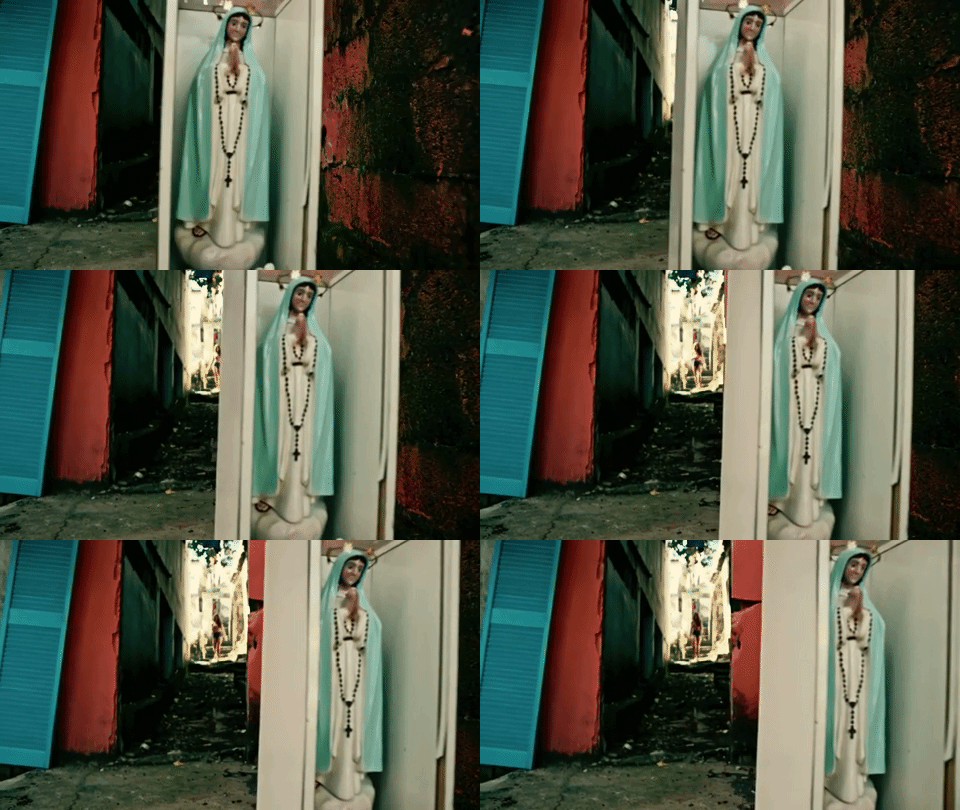
Nine days before they uncovered the bodies, I watched Silvia Esposito perform her family’s late August ritual. In a one-piece Wonder Woman swimsuit, she stomped around a plastic kiddie pool, ankle deep in tomatoes. If I looked at her long enough, maybe I could tuck back the wiry hair escaping her French braid. Maybe her thick eyeglasses wouldn’t fog. Even the Virgin Mary clasped her hands and looked away, safe within her bathtub shelter. Silvia was the only other girl in my grade that lived on my block, and she was an unholy disaster, the kind of girl that not even the Divine Savior moms would pressure you to shake hands with at church. They understood.
“God’s punishment,” they’d say when all six Espositos lined up in their pew.
“Too many babies.”
“With three beautiful boys already,”
“Someone needs to tell them this isn’t the old country.”
One house over, the Catalpa Avenue dads assembled around Norman Bennet’s driveway. Norman Bennet always had something to show off. He had a hi-fi stereo bigger than most of our living rooms, and the neighborhood boys said that he even had arcade games inside his house. On that day, nine days before the start of the carnival at St. Joe’s, he was showing off a brand new bronze speedboat. It had tan, leather seats that looked so soft. The glitter flecks blinked back the sun. All the dads gathered around it at a respectful distance. Their workdays were over, lawns freshly mowed.
A black Trans Am pulled into the Esposito garage, right on schedule. The dad-chatter drowned in Robert Plant’s wailing. When the car was parked, the two older brothers ran right over to the boat. Gio, the youngest of the brothers, rushed home. From the height of my treehouse, seeing all the siblings at once, I understood that when making Silvia from all those wonderful Esposito parts, God got bored and phoned it in.
One of the older Esposito boys, I didn’t know which was which, penetrated the Circle of Reverence established around the boat, poised to lay a hand on the sparkling hull.
“That’s a fresh coat of wax there, boys, hands off,” one of the dads growled.
But Mr. Bennett dismissed the concern. In fact, they should go ahead, climb aboard, show themselves around, he chuckled. And if the boys ever wanted to drive it around sometime, like for real, in the actual water? Well he knew a place — just a few hours away near Holland, Michigan —so quiet you could hear mice screw.
The brothers obliged and climbed into the boat.
Syncopated shrieks spooked Mr. Kowalski’s pigeons from their cuckoo clock-painted shed. At first, I thought the noise was mechanical. Everyone looked around in confusion, trying to pick up the source of that horrible sound.
It was Silvia.
She wailed from the front yard, tomato pulp dripping from her chest, felled at the knees. On the boat, her brothers looked at each other. One bewildered, the other embarrassed. One, barely audible, said they needed to go see what that was all about. The other wondered aloud, where’s Ma?
When the brothers jumped off the boat, Silvia shut up.
In the bewildering silence that followed, Silvia found my eyes and waved.
I prayed no one saw that, no one saw me. She followed her brothers back into the house. I sank into the old pile of Barbies gathered in the corner, their mono-toes chewed. Shame washed over me. Like I had been a part of that somehow. Like I was her friend. Like I understood what she was screaming about.
#
Dinner was the sound of tine against ceramic, the sound of dad’s chewing.
I dried the dishes and retreated to the living room couch with my mom. I asked her to check me for lice because I liked the way it felt when her nails kneaded my follicles, tired from their ponytail burden. On ABC Channel 7 news, the anchors chanted the name Jennifer Goodsell — a fourteen-year-old girl who’d gone missing from the K-mart in Downer’s Grove: Jennifer Goodsell, Jennifer Goodsell. Jennifer Goodsell. The anchor repeated her name over and over like the prayers during a rosary, or local commercials on daytime TV. My mother wondered aloud about her parents, Jennifer Goodsell’s, and what they must have done that was wrong, so very wrong, for God to punish them that way.
I sat up. I didn’t realize that’s how God worked. That he punished little girls for things their parents did. Maybe they were jealous of other people’s things, mom wondered. Or maybe they showed off.
Or maybe it was her. I offered. Maybe Jennifer Goodsell summoned something, using too many swear words in a row, playing demonic board games. Maybe she listened to Led Zeppelin, howling praise for Norse gods.
Mom’s hands continued to caress her thigh, where my head was. She said in her soft, Slavic accent, “Jennifer. It’s not a Catholic name.”
Every few months, a new name, a muddied velour tracksuit in a forest preserve. Divorced parents, not enough church, there were reasons why these girls were snatched away from under the watchful eyes of a loving God. Music and games, Protestants and punks. It was a sign of the end times, the priests said during homilies, along with the rise of the USSR, nuclear weapons, and a Polish pope. As if this was not the way the world had always been.
We didn’t see many boys on TV. Boys just disappeared. They ran away. The boys were fry cook aprons twisted among willow roots, soil wrapped in a letterman jacket, an Iron Maiden t-shirt faded from lye. I thought victim was a word for girls, like it was something we could become, like a babcia, or princess.
Sports, traffic, and weather were up next.
#
Well past my bedtime, cigarettes and skunk drifted into my open window. With them, came guitar solos and laughter, unnerving and deep. The Esposito parties prowled through summer nights like a living thing that gobbled up bad kids so that it grew and grew until it shattered into red and blue light.
I crept out of my bed, our back door, and up to my treehouse. I imagined myself invisible in the dark. The Esposito yard was packed with teenagers, all cackle and smoke. Next summer, I’d be one of them, technically. A teenager. The idea of it horrified me. I was sure I’d be very bad at it. One of the boys said the f-word loudly, three times. They were running low on beer, he complained. He looked a little older than everyone, on account of his full beard.
Cigarette smoke billowed from behind me. I froze, its cherry light extinguished in my periphery.
“Why don’t you give it a rest, all this spying?”
I knew the voice. In the three years since we’ve lived here, it had never directly addressed me. I turned to look at him. His silhouette was that of a grown up, but moonlight abbreviated the four years between us. Smoke rose at his side like incense and I couldn’t find words in my throat, for fear he had been conjured.
“You should come over,” Gio Esposito stood on a branch and rested his elbows inside the treehouse.
“To the party?” Was I in the shadows or in the light? Was it on my face? How often I stared into their yard?
He shook his head, “No. Not to the party. You and Silvie are in the same grade, right? Neighbors?”
This wasn’t the invitation I hoped for.
“And hey, she likes spying, too,” he continued. “She does it from her bedroom, though. We don’t got a treehouse.”
At school, Sylvia’s name morphed into a slur. and I forgot myself. I forgot I was talking to her brother when I said, “Silvia is a freak” with immediate regret when I saw what it did to his face.
“Sorry, I’m sorry,” I scooted closer to him, hoping to undo the wound. “It’s just —” I searched for something empirical, “She was shrieking today. Did you hear that? For no reason. Just standing in the front yard, screaming.”
“Yeah, so? She shrieks,” he smooshed the cigarette into the tree. “You don’t got any brothers, do you?”
I shook my head.
“Well, she’s got three. If she wants people to listen to her, she shrieks.” He said all of this like he approved. Like he understood. Like he was a part of it somehow.
“Come over sometime,” he said and disappeared down the side of the oak tree.
Back in my bed, I listened to the party go on until dawn. I listened to glass breaking, one after another after another. Giovanni Esposito invited me over.
#
Squad cars parked in front of the Esposito house before the sun rose. The commotion drew neighbors out of their homes, and we gathered outside in our hastily donned robes and shoes. Police tape blocked off Mr. Bennet’s property, where his brand new speedboat was covered in red splotches.
Mr. Bennet stood at the end of his driveway. To my surprise, he was relaxed and easy as he spoke to three officers. A fourth officer approached, holding at arms-length what looked like a large shard of glass. That was when I noticed the broken jars on the ground, scattered about. I counted six of them..
“It’s fine, it’s fine. I don’t want to press charges,” Mr. Bennet’s gaze bounced from police to spectators, then back. “These are just dumb kid pranks, there’s no need…”
This was no big deal, he insisted, he just wanted it all behind him. But the neighbors felt differently. They grumbled amongst themselves, why didn’t anyone call the cops on that party once curfew hit? What the hell were Joe and Rosa Esposito thinking? Letting their kids run wild like that? Who were these parents? It was 10 p.m., did they know where their children were? They were on television, on the news, sandwiching the traffic report. They wandered towards the toys section in Kmart. They disappeared.
#
It took me six days to work up the nerve to knock on the Esposito’s front door with a bulky boardgame under my arm. Their house was larger and fancier than most houses on the block,two stories with a white stone exterior. Red, white, and green spotlights turned the whole front of the house into a flag. From among a neat circle of hedges, St. Francis of Assisi grinned into a birdbath from beneath his manicured beard.
Mrs. Esposito called Silvia to come downstairs. When she got to the landing, she hesitated coming any closer to me.
“My parents got me this for good grades,” I lifted the game a little higher so that she could see. “But I’ve been playing it by myself.”
“Life,” she read aloud. Her forehead and nose peeled from sunburn. Her hair was tucked neatly into a French braid, held together by brightly colored, mismatched barrets. “I’ve seen the commercials,” she brightened. “Do you want to play outside? I’ll tell my brother to bring us lemonade.”
I held my breath while she called his name.
I helped Silvia set up a plastic table and three chairs in the culinary garden. Gio brought out a tray of lemonade. In the game, we navigated our destinies from tiny little cars where we packed our growing families. When we were handed our spouses, Silvia gave her brother a blue pin, and he slid it into the passenger seat beside his own. The rest of his car filled up with pink-pin daughters, “all named Silvia.”
At the center of the game was a dial where we spun for our careers and fortunes. Among the cucumber plants and lemonade, an abundance of lightning bugs celebrated twilight. Our lives were all perfect on the board.
The slam of a car door startled us. Gio ran to the side of the house, and we followed him. Someone had pulled into their driveway, a wood-paneled station wagon. A man with a thick beard. He looked familiar, and it took me a while to realize that he looked like the guy who was swearing so loud at the party the other night.
But as he approached the house, I saw that his beard was threaded with salt and gray. The crinkles near his eyes revealed that this was no high school kid. He pounded on the Esposito’s front door.
Where the hell was his kid,? The man yelled. What the hell is going on over there, Joe? It’s been a week. Someone had to have some answers, Rosa! What would you do if this was one of your boys? This was the last place anyone’d seen ‘em.
“Shit,” Gio said, and motioned for Silvia and I to get back in the back yard. “That’s Teddy’s dad.”
“What’s wrong?” I whispered.
“Everything’s fine,” Gio said, “You should go home,” and ran into his house.
Silvia’s eyes were on fire. She ran to the table in the garden and knocked it down, sending the game, all our little cars and family, our stacks of colorful money, flying in every direction. The fake hundreds we worked for floated onto the arugula patch, Gio’s family of Silvia’s rolled among the onions. “Nothing is fine!” Silvia shrieked. “I’m not making things up. I’m not starting crazy rumors. This isn’t fine.”
Mr. Esposito bellowed for his daughter from inside his house and I ran away.
From my bedroom, I wondered how the rest of the conversation went. I wondered if Joe Esposito was more polite to Teddy’s dad than the neighbors. That guy’s kid was a bum, Teddy Demos. Anyone at Holy Cross High School knew what kind of kid Teddy was. He could be anywhere. Shacking up with some broad. Dealing grass, couch surfing somewhere in the bad parts of the city, hitchhiking, getting into trouble, with a kid like that, who the hell even knows?
But, no. His father knew. Teddy was a junior. Teddy did JV football even though he dropped out before varsity. Teddy fell in love with cars so that after school, you’d find him in his uncle’s garage. Teddy Demos, Ted-ee-deee-mos teddiedeeemmmmosss, the news anchors would chant. He was a burnout and a metal head and a loving son. He may have been a little flakey and a lot confused about his direction in life, his father would later tell Channel 32 Fox news, but he wouldn’t let us worry. That’s how we knew. When we didn’t hear for days. Something happened. He wasn’t gonna be OK.
#
St. Joe’s was the Ukrainian church at the end of our block. Every year, they had a carnival right before we went back to school. Kids came from all over the neighborhood. The public school girls stalked around like a pride of lions, their hair teased to menacing heights, pastel fringed t-shirts that hung off bodies that could have been popped out of a plastic mold. There was a new ride that year called the Gravitron. It promised to spin so fast, you’d reach zero gravity, float as if you were in space. But over the summer, all the seventh graders must have decided they were too old for rides. No one else wanted to go. Instead, the girls of Divine Savior moved, swirling and pulsing through carnival stalls in a crowd; safe from predators.
,
We poured through a narrow passageway of stalls and game tents, when a hand landed on my shoulder.
“I have extra tickets,” Silvia said, waving the tickets in my face. She stood in front of a trough, where plastic ducks floated. “This one’s my favorite,” she pointed at the game, her wrists packed with jelly bracelets. “I know which ducks give the best prizes. What do you want? I can tell you which duck to pull.”
She stood a torso taller than all the other kids at the game. Her bangs were loosely held back by mismatched barrettes.
“I can buy you a new Life,” she implored, misjudging my hesitation. “I’m sorry I did that.”
I looked around to make sure the other starlings had disappeared into the carnival before addressing her. “Silvia, this game is for babies.” Pain looked the same way on her face as it did on Gio’s. I hated her for being so loved and so flawed. “And these prizes are garbage no one wants.” Ashamed of her, ashamed of myself, I went to the Gravitron.
From the outside, it looked like a futuristic spaceship, but the inside was more like an unfinished basement. The spaceship rotated slowly at first, picking up speed, enough speed to make people sick and pin us against the wall so that the floor fell out.
It wobbled, like some tiny bolt was about to fly off and find an exit through a kneecap or jaw. My throat. Next to me, a boy with giant feet in high tops clambered about against the wall, trying to invert himself. He kicked around my face and I screamed and screamed at him to be careful, but the sound was lost in the folds of his own cries for his friend Marty to look at him–hey Marty! Hey Look! My throat was raw when the ride stopped.
#
I knocked around the bodies of packed fairgrounds, hypnotized by the deep fried sugar in the air, by the bare bulbs flickering on The Zipper. Over the counter of a game where you shoot water into a clown’s face, Gio leaned. A group of girls fluttered by him with a hi Gio, hey Gio, where are you going after this Gio?
“Is Silvia here?” I asked when I approached him. The music was loud, my voice losing against Debby Harry begging to call me, call me, my love.
“She ran home,” he said. The lights from the octopus ride traveled his face. Red light, then blue light, then red light again. Each color revealed an extraordinary detail. The red light told me he had a delicate cleft in his chin. The blue light showed me the perfect radius of a curl dripping onto his forehead. Sirens wailed and wove into the song. Everything was an emergency. A smile spread across his face, breaking dimples open on both cheeks, in red lights and blue. Screams of delight ebbed and flowed from the octopus and my throat was empty. “She had stuff to do.”
He turned back to the game, pointed the water pistol into the clown’s face, and popped a red balloon.
The entire fairgrounds were red, red and blue, red and blue and in between songs. I was listening to sirens. A third and final firetruck had gone by before I understood that they were responding to a fire down the street. The emptied slowly at first, and then quickly to see the Bennet’s shed had been set ablaze. With his usual jolly grace, Bennet insisted he had everything under control at first. He did his best to douse the fire with his garden hose, half-shadowed in his backyard. But the flames threatened to spread. Silvia watched from her front steps. The colors of the flag dyed her face. Her hair, long and unruly, blew at her sides.
The night hung on a tip of celebration among the neighbors and the firefighters, when the whispering began among the latter. Only the neighbors remained giddy when the police were covertly called. The mood fell somber when they arrived. In their rage, the flames exposed the first body, and then two more. Charred, wrapped in gauze and lye. Over the coming days, every inch of the yard was dug up, and new numbers were announced on the evening news. How many of them could there be? The city eventually recovered from the answer to that question, but it took a while.
The boys were fry cook aprons twisted among willow roots, soil wrapped in a letterman jacket, an Iron Maiden t-shirt faded from lye. The boys were sisters’ boyfriends, the neighbor’s kid. The boys were brothers.
They took Norman Bennett’s house down to its bricks and then even the bricks were carted away. By spring, the land returned to the prairie gods. They’d purify it in ways our own God would not. Reborn with milkweed and hyssop, the soil aerated with worms, who turned their heads away in shame. Thirty-nine bodies in total.
By spring, the Espositos moved to the western suburbs, where all the high school girls had horses and birth control pills. Sometimes, photos of Catalpa Avenue pop up during serial killer marathons and I wonder if any of the Espositos have seen them, seen the photos of their old house.
The colors in those pictures are always off, the blues a little baby-ier, greens all sicker, and the yellows of faded laundry. I convince myself that the world did look that way, less pigmented than the present. They still say his name, syllables running together all meaning erased through repetition: Norman Bennet of Norwood Park, Norman Park of Norwood Bennet, Norwood Norman of Bennet Park. Like the virgins and fruits and wombs. Look at those low rates. Call 588-three-two-hundred, Empire for free carpet installation at the right-hand-side of the father, it must be Eagleman, forever and ever, amen.